First-Year Retention Strategies That Move the Number

First-year retention strategies organized around the four drivers of whether a student stays: money, academics, wellness and belonging. What to do in the first six weeks, who owns each piece, and how to reach quiet students.
Key takeaways
- First-year retention rests on four drivers: money, academics, wellness and belonging. Most students who leave are dealing with more than one.
- The first six weeks set the habits that decide the year: contact before classes, a check-in by week two, help in the first hard week and a question about the first grades.
- Money problems are often the most fixable driver. Pull a hold list in week six and text each student, not just the account.
- Reach quiet students by going to them, and watch for a change from each student's own usual, not just low numbers.
- Run it as one plan across offices, with one shared list, one owner per student and one calendar of messages.
The first-to-second-year retention rate gets reported every fall, and by then it's a year old. The students in it made their decisions months earlier. When advising teams look back at the first-years who didn't return, they often find the signs in October: a hold nobody cleared, a gateway course failed quietly, a student who stopped answering anyone around midterms.
This guide is about first-year student retention strategies that act in that window, while there's still time. It's organized around four drivers of whether a student stays (money, academics, wellness and belonging) because a strategy that addresses one driver through one office rarely moves the number on its own. For each, you'll find what to do, when, and who should own it.
What moves first-year retention, and what doesn't
Our work draws on Vincent Tinto's research on why students persist, and we sort the reasons into four groups. Most students who leave are dealing with more than one at once.
| Driver | How it shows up in a first-year | When it tends to surface | Usual owner |
|---|---|---|---|
| Financial | A hold, an unpaid balance, a missing aid document, too many work hours | Before classes, then before spring registration | Financial aid, the bursar or one stop |
| Academic | Falling behind in a gateway course, not knowing how to study at college pace | First quizzes (weeks 3 to 5), midterms | Advising, tutoring, faculty |
| Wellness | Sleep, stress, homesickness, a mental health problem | Weeks 4 to 8, and again around finals | Counseling, health services, Res Life |
| Belonging | No friends yet, not part of anything, "people like me don't go here" | Weeks 2 to 6, often unspoken | Student life, Res Life, orientation programs |
What tends not to move the number on its own: a strong orientation followed by silence, a single email campaign, or a risk score without anyone acting on it. Each is useful. None reaches a student in week six who has stopped going to class and isn't telling anyone why.
Win the first six weeks
The first six weeks set habits: whether a student goes to office hours, whether they ask for help, whether they know where the one stop is. Strategies that work here are mostly small and well timed.
- Make contact before classes start. A welcome text that says who's on the other end and invites questions. Ask what the student is working toward, in their words.
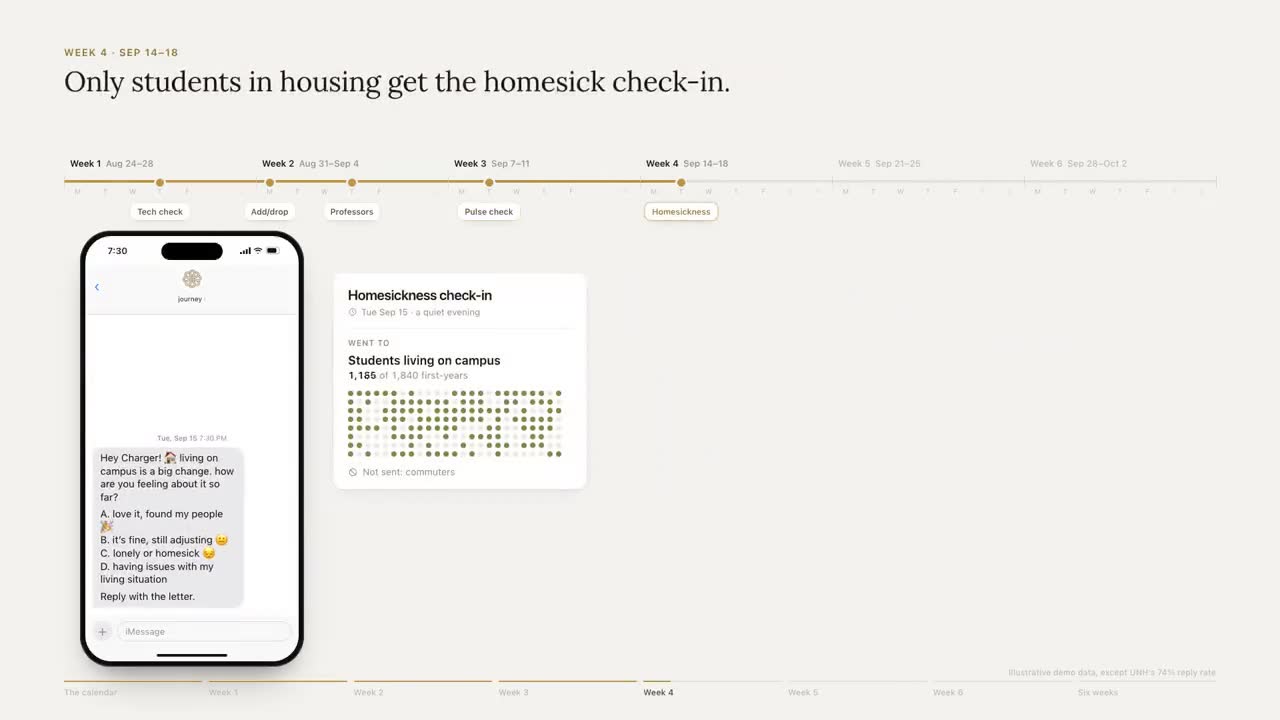
- Check in by week two. One question with lettered choices: how's the first week landing? The replies will tell you who's lost, who's fine and who's already worried.
- Catch the first hard week. Usually week three or four, when the first real assignments land together. Offer one concrete move: tutoring hours, a study block, sleep.
- Ask about the first grades. When the first quiz scores come back, ask how it went. A low score plus "i didn't know how to study for it" is the cheapest academic problem you'll ever solve.
The full week-by-week version is in the first six weeks: onboarding first-years by text.
Clear money problems before they become holds
Financial problems are often the most fixable driver and among the most overlooked, because they live in offices that don't always talk to advising. A hold that blocks spring registration can turn into a student who doesn't come back over the break.
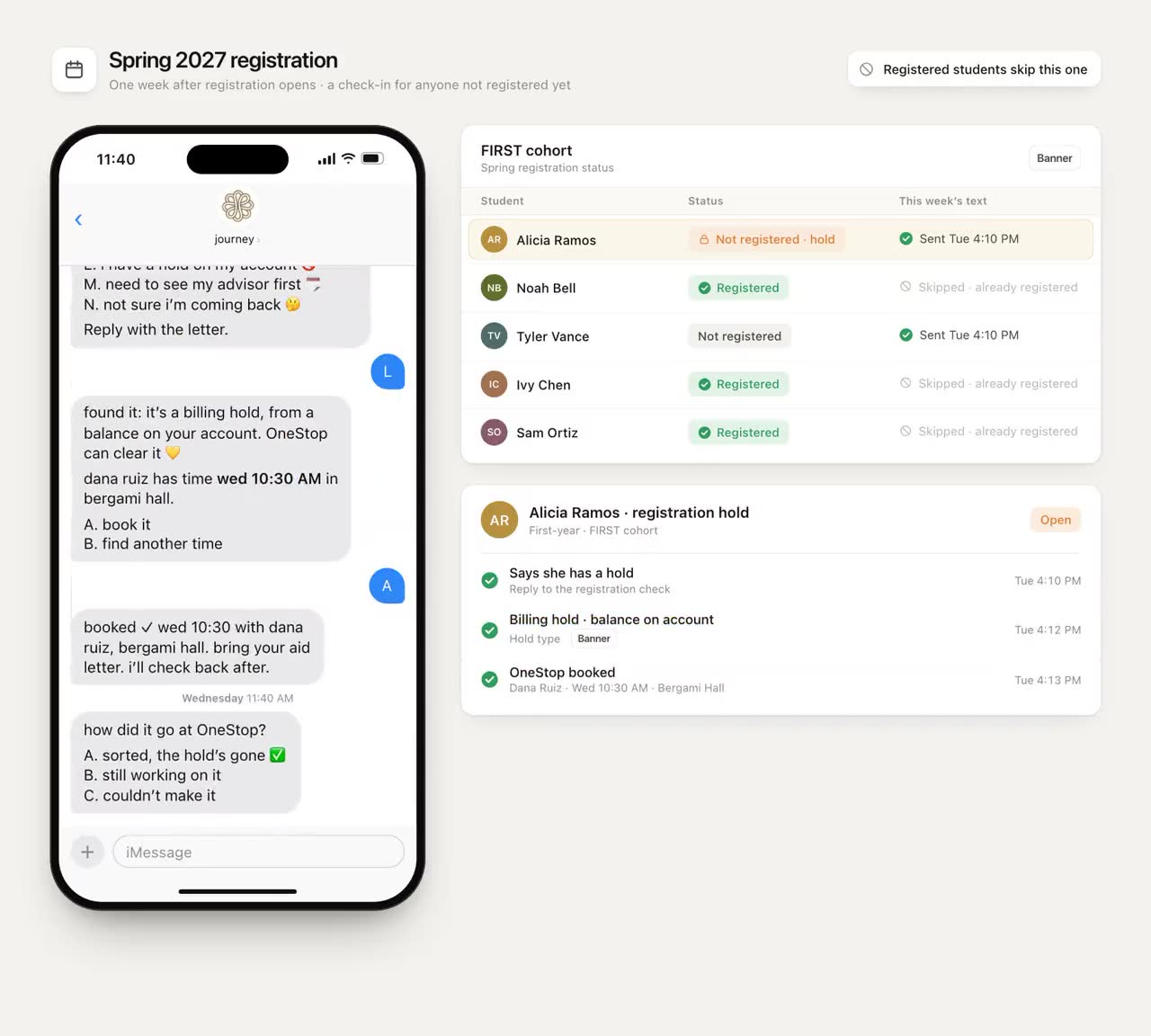
- Pull a hold list in week six, not week eleven. Every first-year with a hold that will block registration, and what it's for.
- Text the student, not just the account. "there's a hold on your account that'll block spring registration. one stop can help. want their hours?" Point to the problem without the dollar amount.
- Check back in a week. Holds that don't clear in a week usually need a person: a payment plan, an appeal, emergency aid.
- Ask about money directly, once. A pulse question that includes "money stuff" as an option surfaces students who would never walk into financial aid on their own.
Deeper playbooks: clearing registration holds, financial aid reminders students act on and getting students to emergency aid.
Back students up in gateway courses
Gateway courses (the intro math, chemistry, biology and writing courses most first-years take) decide a lot of first years. A D or an F in one can cost a semester of progress toward a major, and a student who starts to wonder whether they belong in it.
- List your gateway courses and their DFW rates (the share of students who get a D or an F or withdraw). That's your map of where to put tutoring and early checks.
- Time help to the exam calendar. Tutoring offered the week after a failed exam is help for the next one. Offer it the week before.
- Ask faculty in those courses for an early flag in week three or four, with a form that takes a minute. See faculty early alerts professors will send.
- Make office hours less mysterious. Many first-years don't know what office hours are for. A text that says "office hours are just you, the prof and your questions. 10 min is fine" does more than a syllabus line. More in getting first-years to office hours.
Wellness and the second-month dip
Somewhere between weeks four and eight, the novelty wears off. Sleep gets shorter, the first grades land, homesickness shows up, and the student who seemed fine in September stops replying. Wellness strategies that help here are preventive and specific: a nudge toward sleep the night before a hard day, ten minutes outside when the weather turns, a check-in when replies drop off.
The other half is getting students to counseling when they need more than a nudge, and before a crisis. That needs a clear path from any reply that sounds like distress to a person, and an honest line about what a text can and can't do. See student mental health support by text and homesickness in the first semester.
Build belonging one connection at a time
Belonging rarely comes from a big event. It comes from one person who knows your name, one group you're part of, one place on campus that feels like yours. Strategies that work at scale go after that first connection:
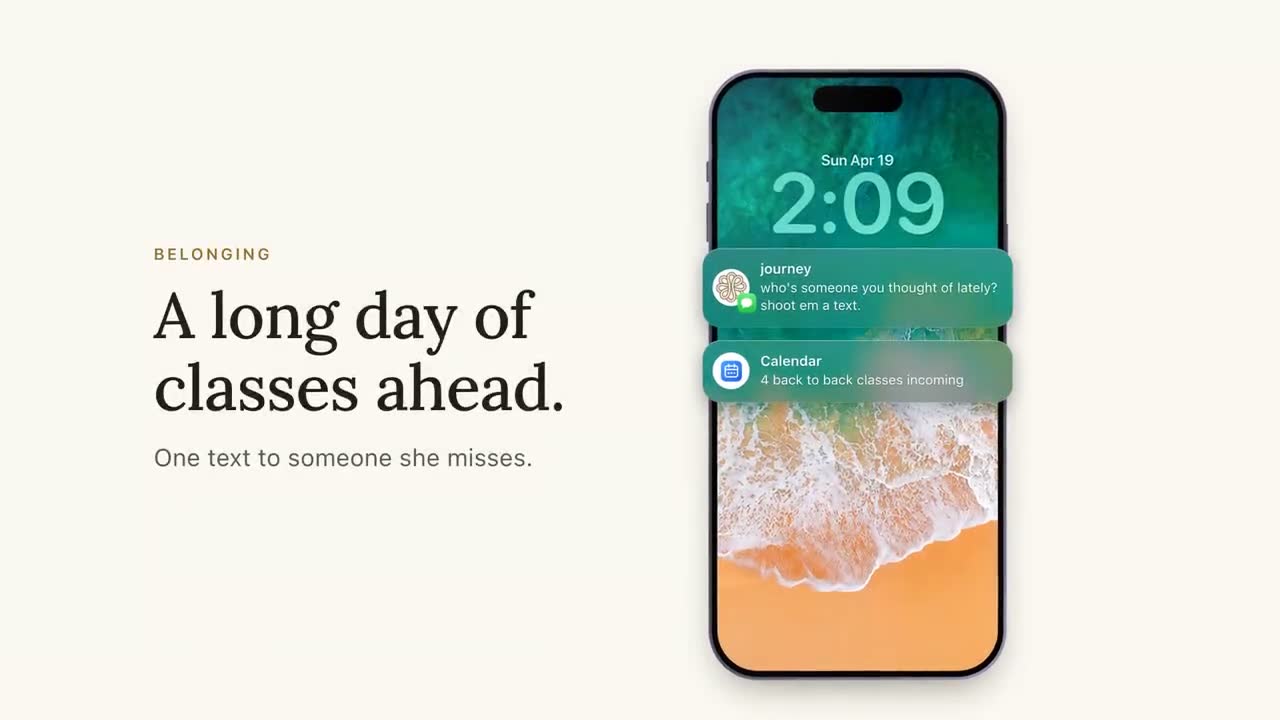
- Invite students to events that match what they said they care about, not to everything.
- Size it for the student: "a small group, 8 people, board games" lands differently with an introvert than "the big welcome party".
- Give commuters and working students options that fit their hours. The 7 PM mixer misses everyone on the night shift.
- Ask, once a month, whether they've found their people yet. The answer is worth knowing.
More in building a sense of belonging at scale, and for two groups that often feel it least, commuter students and first-generation students.
Reach the quiet students
Every strategy above has the same weak point: the students who most need it are the least likely to show up for it. They skip orientation sessions, don't open email, don't come to events and don't book appointments. Two things help.
First, go to them. A text reaches a student who never opens a portal, and a question with lettered choices takes almost no effort to answer. Second, watch for change, not just level. A student who always replied and suddenly stops is telling you something, even if their grades look fine so far. That shift from a student's own usual is often the earliest signal you'll get; we cover how to read it in identifying at-risk students before midterms and what to do about it in the midterm slump playbook.
What one pilot showed
Journey was built for this stretch of the year. It texts each first-year a few times a week, in the voice she chose, about the goals she set: a study block before a midterm, the career fair, a hold to clear. When a reply is about money, a course or how she's feeling, Journey points her to the office that handles it, and the student-success team sees a short list of who needs a person this week.
At the University of New Haven, we worked with a cohort of first-years the university considered high risk. Of about 100 high-risk first-years in the University of New Haven pilot, 4 left. The semester before Journey, 50 high-risk first-years did. That's one cohort at one campus, measured against the semester before rather than in a controlled trial, so read it as an early result, not proof. The results page has the details.
Run it as one plan across offices
The four drivers belong to different offices, and the student meets all of them at once. A hold, a failed quiz and a lonely week can all arrive in the same two weeks. Strategies run office by office miss that, and they also collide: four offices texting the same student on the same Tuesday.
- A small first-year working group. One person each from advising, financial aid, student life, counseling and Res Life, meeting for thirty minutes every two weeks in the fall.
- One shared list of first-years with an open issue, with one owner each, set by what the student said rather than by which office noticed first.
- One calendar of messages, so the student hears from the campus a few times a week, not from each office separately.
- A plain agreement on sharing. What offices can tell each other about a student, and when, worked out with your registrar and counsel under FERPA before the term starts, not in the middle of a case.
And talk to the students who don't register for spring while they're still enrolled. A text and then a call in December finds out whether it's money, grades or something else, and some of those reasons can still be fixed. If they leave anyway, re-enrollment outreach is easier when the last conversation went well.
Choosing where to start
You can't do all of this in one term. Pick one strategy per driver, assign an owner, and measure something you can see before the semester ends.
| Strategy | Driver | Owner | When | Measure |
|---|---|---|---|---|
| Hold list and text outreach | Financial | One stop with advising | Week 6 | Share of holds cleared before registration opens |
| Early flags in gateway courses | Academic | Advising with faculty | Weeks 3 to 4 | Hours from flag to the student's phone; tutoring visits that followed |
| Evening-before nudges and quiet-student check-ins | Wellness | Student success or counseling outreach | Weeks 4 to 9 | Reply rate among students who had gone quiet |
| Matched event invitations | Belonging | Student life | Weeks 2 to 6 | First-years who attended at least one event |
Track fall-to-spring persistence for the cohort as the outcome, and these as the early signs that it's working. If the early signs don't move by midterms, change the strategy before the term ends rather than after the number comes out.
Frequently asked questions
What are the best strategies to improve first-year student retention?
Work across four drivers at once: clear holds and money problems early, back students up in gateway courses before exams, catch the wellness dip around weeks four to eight, and help each student make one real connection. Start in the first six weeks, and reach students by text rather than waiting for them to come in.
Why do first-year college students drop out?
Usually for a mix of reasons across money, academics, wellbeing and belonging rather than one. A hold, a failed gateway course and a lonely month can arrive together, which is why strategies run by one office at a time miss many students.
When should colleges step in with at-risk first-year students?
In the first six weeks, and before midterm grades post. By the time a midterm grade or a registration hold makes the problem obvious, the cheapest fixes have often passed.
How can we tell a retention strategy is working before the year ends?
Track early signs you can see within the term: holds cleared before registration, hours from a faculty flag to the student's phone, reply rates among students who had gone quiet, and first-years who attended at least one event. Then track fall-to-spring persistence for the cohort as the outcome.