Faculty Early Alerts Professors Will Actually Send

Why faculty early alert participation drops off as the term goes on, and how to fix it: a one-minute form, a clear note on what FERPA allows, a one-line update after every alert and a digest that shares signal, not names.
Key takeaways
- A common reason professors stop sending alerts is that they never hear what happened. A one-line update within a week of each alert is the fix everything else depends on.
- An alert should take a minute: three fields, five or six preset reasons, several students at once, and email accepted.
- Ask for alerts right after the first graded work, after midterms and before the last day to withdraw, not on day five.
- A short note from the registrar on what FERPA allows professors to share removes a quiet barrier to alerts.
- A digest of patterns from students in their own sections, with no names and small numbers suppressed, gives professors something useful back.
It's the Friday of week three. A biology professor with two large lecture sections has a list of students who didn't turn in the first lab report. The early-alert form wants a student ID, a reason from a long dropdown, a description, and whether she's already contacted the student. She files four alerts before her office hours start, means to do the rest later, and never hears what happened to any of them. In week eight, with a stack of midterms to grade, she files none.
Faculty early alert participation falls off for reasons that have little to do with whether professors care. The form takes too long, nothing seems to happen, and some aren't sure what they're allowed to share. Each of those is fixable. This playbook covers why professors stop sending alerts, how to make an alert a one-minute task, what to tell them afterward, and how a short digest can give faculty something useful back without naming students.
Why faculty stop sending early alerts
| Why they stop | What fixes it |
|---|---|
| They never hear what happened | A one-line update within a week of every alert |
| The form takes five minutes per student | Three fields, preset reasons, and flagging several students at once |
| They worry an alert will label or punish the student | Say plainly what an alert triggers: a supportive text and an offer of help, not a mark on a record |
| They aren't sure what FERPA allows | A short, accurate note from the registrar on what they can share and with whom |
| The request comes before they know anything | Ask right after the first graded work, not on day five |
| Alerts feel like extra work with no return | A digest that helps them teach, such as what students in their sections say they're stuck on |
The first row matters most. A professor who flags a student and hears nothing has learned, reasonably, that the flag went nowhere. Every other fix depends on that one.
Make an alert a one-minute task
An alert form should take less time than writing the email the professor would otherwise send. In practice that means:
- Three fields. Who, what you noticed, how soon it matters. Everything else, such as the student's advisor, program and history, the system can look up.
- Five or six preset reasons. Missing work, attendance, low grade, seems stressed or unwell, not engaging, other. A long dropdown makes professors pick the wrong one or none.
- Several students at once. Let a professor select everyone who missed the first lab and flag them in one step, with the same reason.
- Whatever channel they already use. Many professors will never open an alert system but will send an email. Accept it, and turn it into an alert on your side.
- The right moments. Ask for alerts right after the first graded assignment, usually weeks three to four, again after midterms, and a week or two before the last day to withdraw. Send the request with a direct link, from someone they know.
Tell professors what an alert sets off
Professors are more willing to send alerts when they know exactly what happens next, and less willing when they imagine a disciplinary file. Put the sequence in the request itself, and only promise what your team can keep. An example, to adapt:
| When | What happens |
|---|---|
| The same day | The student gets a short, friendly message asking how the course is going, with an easy way to answer |
| Within two business days | An advisor or success coach owns the alert and reaches out personally if the student hasn't answered |
| Within a week | You get a one-line update, with no private detail |
| When it's resolved | The alert is closed in the record, and nothing is added to the student's academic file |
Check that last row with your registrar before you print it. If alerts are kept as records, say so plainly and say who can see them.
What professors are allowed to share
Uncertainty about privacy quietly suppresses a lot of alerts. Professors have heard FERPA means "don't share anything", so they share nothing. The reality is more workable, though your registrar should confirm how your campus applies it:
- FERPA generally allows information from education records to be shared with other school officials who have a legitimate educational interest, as your institution defines it. Advisors and student success staff working with the student usually qualify.
- According to the U.S. Department of Education's guidance, FERPA generally doesn't cover what a staff member knows from personal observation, such as "he seemed exhausted and left early", though there are limits, and institutional policy can be stricter.
- The alert should still include only what's needed to help. "Missed two labs, seemed stressed" is enough. Speculation about the cause isn't.
This is general information, not legal advice. A one-paragraph note from your registrar, sent with the alert request, answers the question many professors are too busy to ask.
Tell them what happened
Close the loop with the professor within a week, in one line, without private detail. The aim is to show the alert led somewhere, not to share the student's story.
| Send | Don't send |
|---|---|
| "Thanks for flagging Alicia. She's connected with tutoring and is meeting her advisor this week." | "Alicia told us her mother is sick and she's been working extra shifts." |
| "We reached him; he's working on a plan with his advisor." | "He's seeing a counselor." |
| "We haven't reached her yet and we're still trying. If you see her in class, a quick word helps." | Nothing at all |
The third row matters. Faculty can accept that some students don't answer. What erodes trust is silence, which reads as nobody trying.
A digest that shares signal, not names
Alerts flow one way: from professor to staff. A short digest can send something useful back. Every week or two, during the busiest stretch of term, each professor gets a few lines about their own sections, drawn from what students say when they're checked in with:
- Patterns in what students say they're stuck on ("several students in your sections mentioned the lab report format")
- Timing pressure ("many of your students have two other exams the same week as yours")
- Status updates on alerts that professor raised
No names, except on alerts that professor raised. And watch small numbers: in a twelve-person seminar, "two students said they're struggling with money" may identify someone. Set a minimum group size below which a pattern isn't reported at section level.
A good digest gives professors a reason to read it: a cue to clarify an assignment, to mention tutoring in class or to move a due date. That's when alerts stop feeling like a one-way favor.
Positive alerts count too
Some campuses let faculty send a kudos alert through the same form: a student who turned things around, or asked a great question. It takes a professor ten seconds, it gives student success staff a positive reason to reach out, and it keeps the form from being only about bad news. If your system allows it, include it in the request.
How Journey follows up on an alert
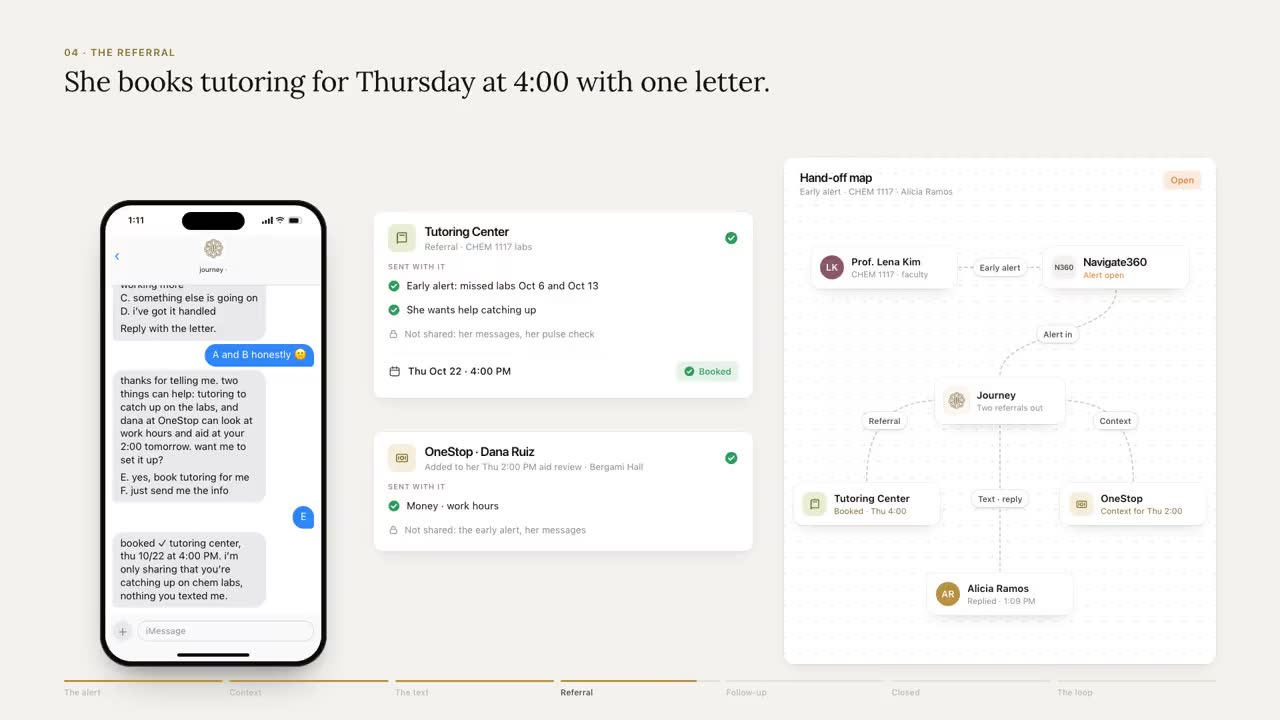
Journey picks up an alert where most processes slow down: reaching the student. When your team passes Journey an alert, Journey texts the student with one easy question, reads the reply for what it's really about, gets them to the office that can help with a one-tap link, and checks back afterward. The partner dashboard shows staff whether the student needs a person and what the concern is, which makes the one-line update to the professor quick to write. Where your early-alert system offers an API or an export, Journey can read alerts from it.
Three things in this article aren't shipped: a faculty digest built from Canvas section data, turning a professor's email into a referral, and two-way sync with an early-alert platform. Today, the update to the professor comes from your staff. For the full follow-through after an alert is raised, see how to close the loop on every early alert.
What to measure
- Faculty who sent at least one alert, as a share of those teaching first-year courses, by term.
- Alerts by week of term. A sharp fall after week four usually means the loop isn't closing for professors.
- Time from alert to student contact. Hours, not days.
- Alerts with an update sent to the professor. The target is all of them.
- Repeat senders from one term to the next. The best sign the process is worth their time.
Start with one department
Pick a department that teaches gateway courses, such as chemistry, biology or math, and ask the chair for ten minutes at a department meeting. Show the three-field form, the registrar's note and an example of the one-line update. Run it for a term. Then bring the participation numbers to the next department, along with a professor from the first one willing to say it was worth it. Faculty listen to faculty.
Frequently asked questions
Why don't faculty submit early alerts?
Common reasons are that they never hear what happened, the form takes too long, they worry about labeling the student or aren't sure what they can share, and the request comes before they've graded anything. Each of these can be fixed.
How do you increase faculty participation in early alerts?
Make the form a one-minute task, ask at the right moments in the term, send a one-line update after every alert and give professors something back, such as a digest of what their students say they're stuck on. Start with one department and let its faculty make the case to the next.
Can professors share student concerns under FERPA?
FERPA generally allows information from education records to be shared with school officials who have a legitimate educational interest, and Department of Education guidance says it generally doesn't cover what someone knows from personal observation. Policies vary, so check with your registrar or counsel.
What should we tell a professor after they submit an early alert?
One line within a week that shows the alert led somewhere, such as "she's connected with tutoring", without private details. If you haven't reached the student yet, say so; silence is what erodes trust.