Building a Sense of Belonging at Scale

Belonging rarely shows up in your data until a student talks about leaving. What it means for retention, the moments in the year it breaks, small prompts that help, peers over pamphlets, and how to measure it.
Key takeaways
- Belonging surfaces sideways, in phrases like "everyone already has their friends" or "i've been going home most weekends", often well before a student mentions leaving.
- It breaks at predictable moments: the first weekend, weeks three to six, after a bad first grade, during breaks and on the return in January.
- Small prompts do the daily work: one text to a friend, one club, and "you won't be the only one" before a break.
- Peer introductions should be matched on real things in common and opt-in on both sides.
- Measure it with a one-question text pulse in weeks 3, 8 and 13, plus event attendance and next-term registration for students who report low belonging.
A first-year commuter eats lunch in her car three days a week, because the student center at noon feels like a room full of people who already know each other. A residential first-year's roommate goes home every Friday, and by Sunday he's said maybe twenty words all weekend. Neither of them would describe it as a problem with belonging. Both are already wondering, a little, whether this was the right school.
A sense of belonging for college students is the feeling that they matter here: that people know them, that they fit, that someone would notice if they stopped showing up. This guide covers why it matters for retention, the moments in the year when it breaks, the small prompts that help, why peers beat pamphlets, and how to do any of it for a whole class without it feeling intrusive.
What belonging means for retention
We frame persistence around four drivers, drawing on Tinto's research on why students stay: money, academics, wellness and belonging. The first three tend to show up in your data. A hold appears on an account; a midterm grade comes in low; a student mentions to an advisor that they can't sleep. Belonging rarely shows up anywhere until it's late, because students don't text an office to say they feel invisible.
When it does surface, it usually comes in sideways:
- "everyone already has their friends"
- "i've been going home most weekends"
- "idk if this is the place for me"
- "thinking about transferring closer to home"
That last one is why belonging belongs in a retention conversation. A student who doesn't feel connected often starts to treat leaving as a reasonable option, and other reasons to go (a cheaper school, a program at home, a partner elsewhere) get easier to act on.
One of the better-studied ideas in this area is a brief exercise for incoming students. They read stories from older students saying that worrying about fitting in is common in the first year and tends to ease with time, then write a little about it themselves. Researchers have tested versions of it in randomized trials at many U.S. colleges. The idea is to change how a student reads a hard week: a lonely October means "this is normal and temporary" instead of "i don't belong here". The trials also suggest it helps most where the campus actually offers the people and places that make belonging real. The message opens the door; the campus has to be there when the student walks through.
The moments belonging breaks
Belonging doesn't erode evenly. It cracks at predictable points in the year, and each one has a small, timely response.
| Moment | What's happening | A small prompt |
|---|---|---|
| The first weekend | Orientation programming ends and the schedule goes blank | Two things happening Saturday, with times |
| Weeks 3 to 6 | Friend groups have formed; the student isn't in one yet | "join one thing this month, not five" |
| After the first bad grade | "maybe i'm not cut out for this" slides into "maybe i don't belong" | One quiz isn't a verdict, plus the tutoring link |
| Fall break and long weekends | The hall empties; the student who stays feels it | What's open, and who else is around |
| Thanksgiving and winter break | International students, students far from home, students who can't afford to travel | "you won't be the only one", plus introductions |
| The return in January | Friends compare break stories; some friends didn't come back | A check-in the first week back |
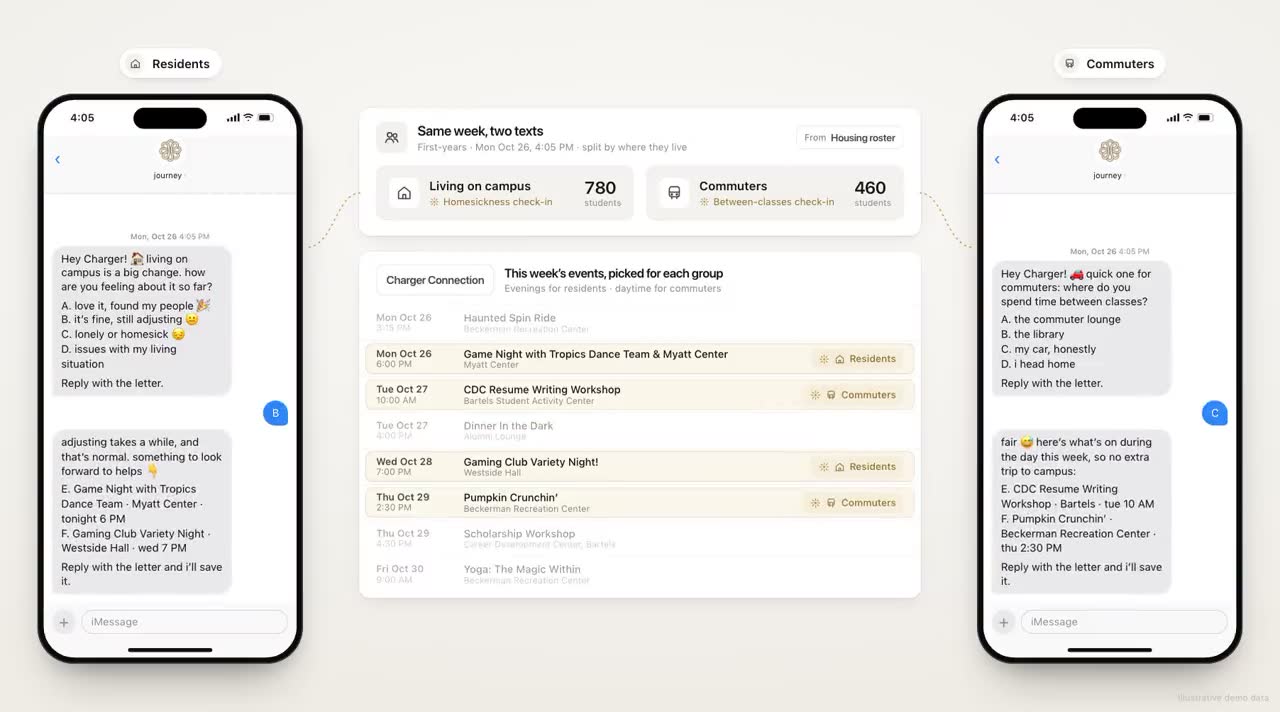
| Between classes, for commuters | Three hours on campus with nowhere to be | A midday event, a lounge, a study group in that window |
Small prompts that help
Big belonging programs matter, but the daily experience of belonging is made of small things: a text to an old friend, one club, one person who says hi. The prompts that help are small, concrete and easy to say yes to.
- Reconnect with someone. "who's someone you thought of lately? shoot em a text." Belonging doesn't have to start on campus, and a text to someone familiar is an easy first practice at reaching out at all.
- One thing, not a list. "one club this month. which sounds most like you?", then three lettered options the student might actually like, such as climbing, the cooking club and intramural volleyball, based on what they told you.
- Normalize, once. "lots of first-years feel like this around now. it usually gets easier, and it's not a sign you picked wrong." Say it once and then offer something to do. Repeating it sounds like a script.
- Breaks. "staying on campus over break? you won't be the only one." For a student who thought they'd be alone in an empty dorm, that sentence can change the week.
None of these ask the student to describe their loneliness or read a resource page. Each suggests one action and makes it easy.
Peers over pamphlets
A list of student organizations is information. A sophomore who grew up two towns over, is also in the nursing program and also works weekends is a person. The second one is what helps.
Peer connection works best with a few guardrails:
- Match on a few real things in common. Major, hometown region, first-generation status, a job, an interest the student named. Two or three overlaps give a conversation somewhere to start.
- Ask both people first. The student says yes to meeting someone; then the peer mentor says yes to that student. Nobody gets an introduction they didn't agree to.
- Make the first meeting specific. Coffee Thursday at 3 at the student center, not "you two should connect sometime".
- Check back once. "did you and nia meet up?", with yes and not yet as lettered choices. If not yet, offer a time. If it didn't click, offer someone else, no fuss.
Breaks, when the campus empties
Thanksgiving is the clearest test. Much of the hall goes home on Tuesday. The students who stay include international students, students whose families are far away or can't afford the trip, students who work through the break, and students for whom home isn't a good place to be. Each of them may assume they're the only one.
A simple sequence handles it: a week before, ask everyone in housing about their plans with two lettered choices. Students heading home get a short "safe travels" with the dates classes resume. Students staying get the break basics the day before it starts (dining hours, what's open, who's on call) and an offer to meet a few others who are around. Res Life owns the list; student activities owns anything happening that weekend.
Doing it at scale without being creepy
Belonging work goes wrong fast when it feels like surveillance. A student who gets a text saying "we noticed you haven't been to the dining hall" will feel watched, not welcomed. A few rules:
- Ask, don't infer. Let students tell you how it's going. Don't announce conclusions drawn from swipe data.
- Always offer "not now". Every prompt should have an easy no, and a no should end the topic for a while.
- Introductions are opt-in on both sides. No exceptions.
- Staff see themes, not transcripts. "Not feeling connected" is enough for an RA or a retention coordinator to act on. The student's own words stay between them and the text line.
- Know where the edge is. Loneliness can deepen into something heavier. Prompts about belonging need the same safety routing as anything else a student might reply to.
Give belonging an owner
On most campuses belonging is everyone's job, which in practice means it's nobody's on a Tuesday. Res Life runs floor programs, student activities runs events, the first-year office runs orientation, and the student who said "i don't really have anyone here" falls between them. Name one owner for the weekly list of students whose replies or pulse answers point to low belonging. That person doesn't do all the follow-up. They make sure each student on the list has one specific next step and one named person by Friday:
| What the student said | Next step | Who |
|---|---|---|
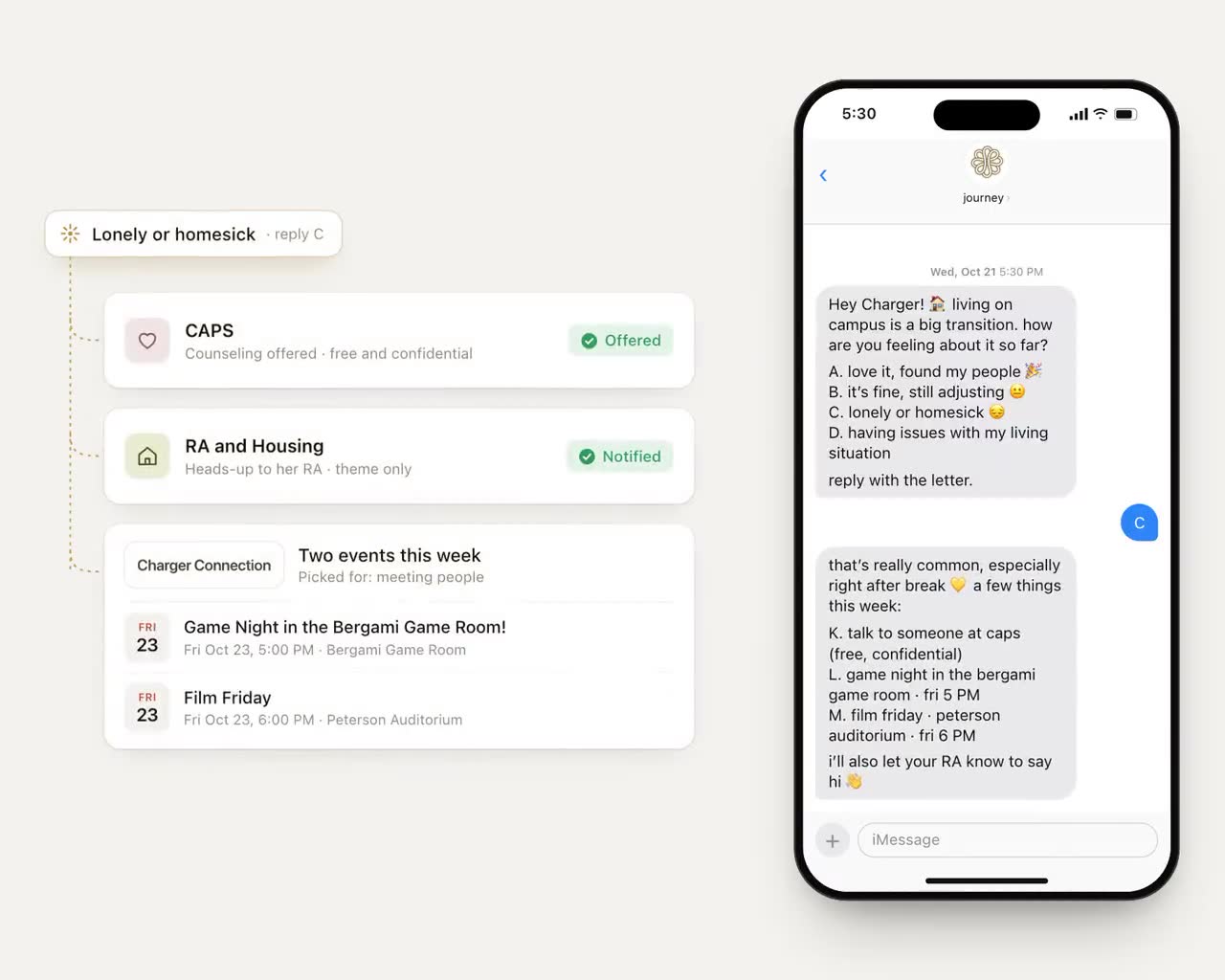
| Lonely, lives on campus | A hello from the RA and an event this week | Res Life |
| Lonely, commutes | A midday group or lounge that fits their schedule | Commuter or first-year office |
| Wants to meet people like them | A peer mentor introduction, both sides opted in | Peer mentoring lead |
| Lonely and not sleeping, not eating or not going to class | A conversation with a counselor | Counseling, through your escalation process |
Belonging nudges and flags in Journey
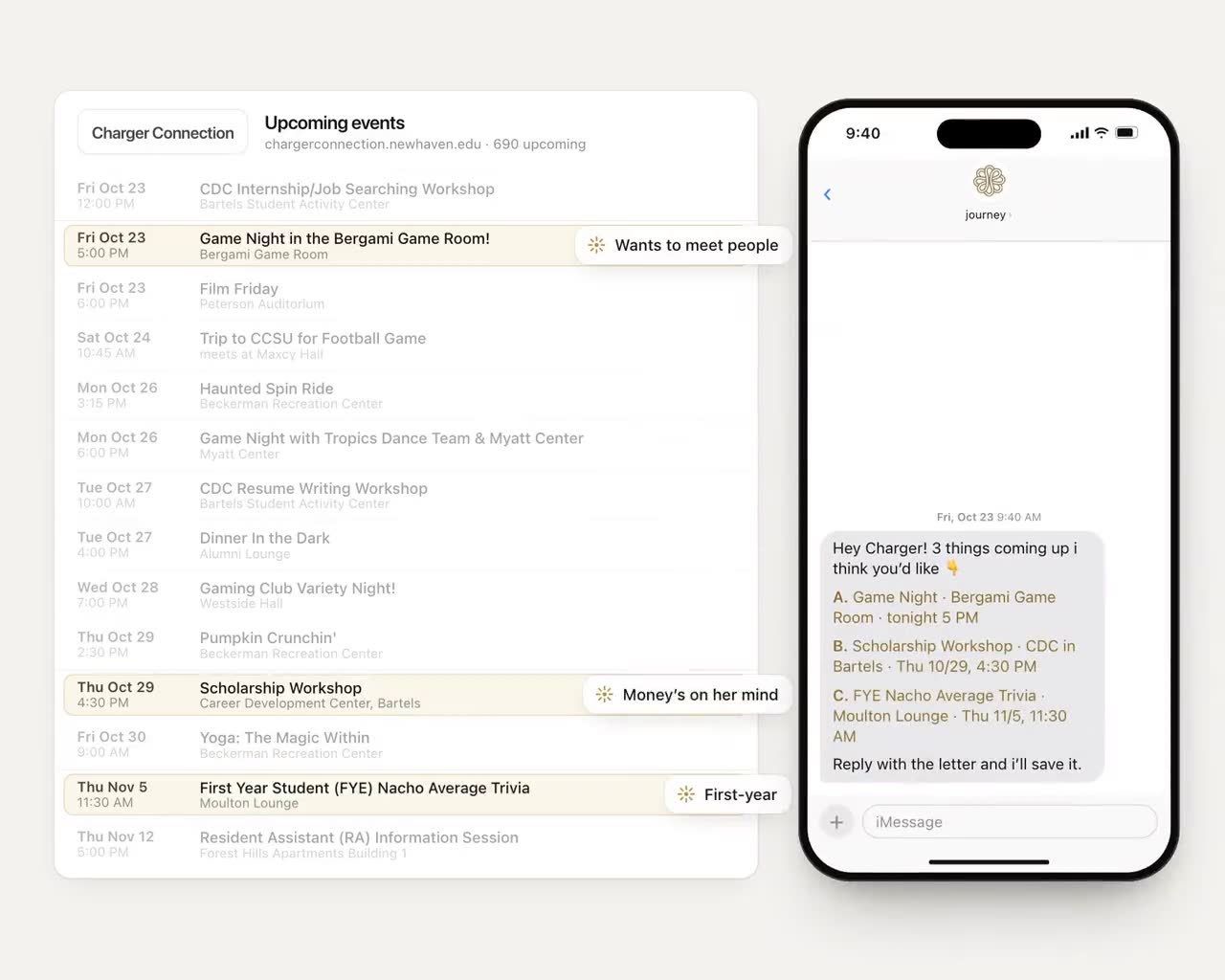
When students sign up for Journey, some rank making friends near the top of their goals, and the nudges they get start there: the "who's someone you thought of lately" text, a break check-in, an event they'd like this week. When a reply says something like "honestly i don't really have anyone here", Journey tags it as a belonging concern and flags it on your team's partner dashboard for follow-up, without the transcript. Journey is not a crisis line: when a message raises a safety concern, it surfaces the right human path (counseling, 988, the on-call staff your team names) and follows the escalation process set up with your campus.
Peer matching and break-time introductions, as shown in the two demos above, aren't live yet. Today, a student who answers yes to meeting someone in a check-in shows up on the dashboard for whoever runs peer mentoring, and the introduction happens through your program.
How to measure belonging
- A one-question pulse. "how true is this for you: i feel like i belong here", with four lettered answers from "very true" to "not at all". Ask it by text in week 3, week 8 and week 13. The trend matters more than any single week.
- At least one event by week four. The share of first-years who went to something, from check-ins or a "did you make it?" text.
- Peer introductions that happened. Of the yeses, how many met.
- Reply themes. The share of replies tagged "not feeling connected", by week and by group, so you can see whether commuters or students in one hall are carrying more of it.
- Next-term registration for students who answered "not really" or "not at all", compared with the class as a whole.
Start with one group, say first-years in one residence hall plus the commuters in the same first-year seminar, and run the pulse, the small prompts and the break sequence for a semester. If the week-13 pulse moves and the low-belonging group registers for spring, you'll have the case for doing it for the whole class.
Frequently asked questions
What is a sense of belonging for college students?
It's the feeling that a student matters on campus: that people know them, that they fit, and that someone would notice if they stopped showing up. It's one of the drivers of whether students persist, alongside money, academics and wellness.
How can colleges improve students' sense of belonging?
Focus on the moments it breaks, such as the first weeks, breaks and the stretch after a bad first grade, and offer small, specific steps: an event the student would like, one club, an introduction to a peer mentor. Ask rather than infer, and make every invitation easy to decline.
How do you measure sense of belonging in college students?
A one-question pulse asked a few times a term, such as how true "i feel like i belong here" is for the student, shows the trend. Pair it with event attendance, peer introductions that actually happened, and next-term registration for students who report low belonging.
Why does sense of belonging matter for retention?
Students who don't feel connected often start to treat leaving as a reasonable option, and other reasons to go become easier to act on. That's why belonging belongs in a retention plan, even though it rarely appears in early data.