Student Mental Health Support by Text: What's Safe and What Isn't

Texting can help students with stress, sleep and getting to counseling sooner. It can't be therapy or a crisis line. Where to draw the line, and four safeguards to set with your counseling center first.
Key takeaways
- Text support does well with small, frequent things: a reset before an exam, sleep around pressure points, and plain answers about how to see a counselor, with a link to book.
- It must not diagnose, counsel, act as a crisis line or promise confidentiality it can't keep when a student's safety is at risk.
- Set four safeguards before the first text: consent with a plain explanation, neutral first lines on the lock screen, named people for escalation and an after-hours plan.
- Late-night stress deserves a calm reply and a daytime option. Crisis language never waits for morning.
- Your counseling center should write the escalation list, approve the first reply to safety language and review every case.
It's 11:52 on a Sunday night in week six. A first-year texts: "cant sleep. stats midterm at 9 and i feel sick about it." The counseling center opens at 8:30. Whatever answers her in the next minute is, for that minute, the campus's mental health support.
Student mental health texting can do real good in that minute, and it can do real harm if it pretends to be something it isn't. Texting is well suited to small, everyday support: a reset before an exam, a nudge toward sleep, a plain answer to "how do i see a counselor here", and a booking link that takes ten seconds. It is not therapy, it is not a diagnosis, and it is not a crisis service. This guide is about drawing that line on purpose, before the first text goes out, with your counseling center holding the pen.
What text support does well
The strongest case for texting is that students read texts. Email from an office they don't know gets filed. A short text, in a tone they picked, at a time they chose, tends to get an answer. That makes text a good channel for the small, frequent things that keep a hard week from becoming a lost month.
- Small resets in the moment. A four-count breath before an exam, ten minutes of wind-down before bed, one next step when a student says everything is too much. Small enough to do right now, which is the point.
- Sleep and routine around pressure points. The night before the first midterm, the Sunday before finals, the week after a long break. You know these dates in advance, so the support can arrive before the spiral, not after it.
- Naming what's normal. "a lot of people hit a wall around week six" is not treatment. It is information, and it can take the shame out of asking for help.
- Lowering the barrier to counseling. Where is the counseling center, is the first appointment free, what happens in it, can I go this week. These are the questions students will text at midnight and rarely email at noon. Answering them clearly, with a link to book, is how text gets a student to a counselor sooner.
- Checking back. A short follow-up after the intake or the exam tells the student someone noticed, and tells staff whether a referral turned into a visit.
What it must never pretend to be
The risks in this work come from blurred roles more than bad intentions. A tool that chats warmly at 1 AM can drift, one reply at a time, into something that looks like counseling. Draw the boundaries in writing.
| Text support can | It must not |
|---|---|
| Offer a breathing exercise or a wind-down | Offer treatment, a diagnosis or a label ("sounds like you have anxiety") |
| Explain how to see a counselor and help book it | Stand in for a counselor, or be used to justify a longer waitlist |
| Recognize safety language and get it to people | Act as a crisis line, or try to talk a student through a crisis |
| Tell students plainly what is shared and with whom | Promise confidentiality it can't keep when a student's safety is at risk |
| Ask a light check-in question with lettered choices ("how's the week landing?") | Run clinical screening instruments, unless the counseling center owns that process |
The law is starting to draw some of these lines too. Since 2025, several states, including Illinois and Nevada, have passed laws restricting the use of AI to provide mental health care, and others have added disclosure or crisis-referral rules for chatbots. The details differ by state and are still changing. This is general information, not legal advice; ask your counsel which rules apply to your campus and your vendors.
Four safeguards to set before the first text
1. Consent and a plain explanation
Students should opt in, and they should know in ordinary words what they're texting with: an automated assistant, with campus staff behind it. Tell them what staff can see, and tell them the one exception that matters most: if they say they're not safe, a person on campus will be told so they can help. Put that in the first week's texts, not only in the terms. A student who learns the rule after the fact feels watched. A student who knew it from day one has no reason to.
2. Lock-screen privacy
On many phones, the first line of a text shows on the lock screen or in a banner, where a roommate, a teammate or a parent at the dinner table can read it. So the first line of anything sensitive should be fine to read aloud in a dining hall. "quick check-in from journey" is fine. "following up on your counseling referral" is not, and neither is anything about money trouble, grades or family. The detail can wait inside the thread for when the student opens it.
3. Named people for escalation
"Safety concerns go to staff" is not a protocol. A protocol names the role that gets the alert during business hours, the role that gets it after hours, how they're reached, and how fast they act. Your counseling center should write the list of language that triggers it, and review it each term. The companion guide on crisis language, 988 and escalation sets out those rules in detail.
4. An after-hours plan
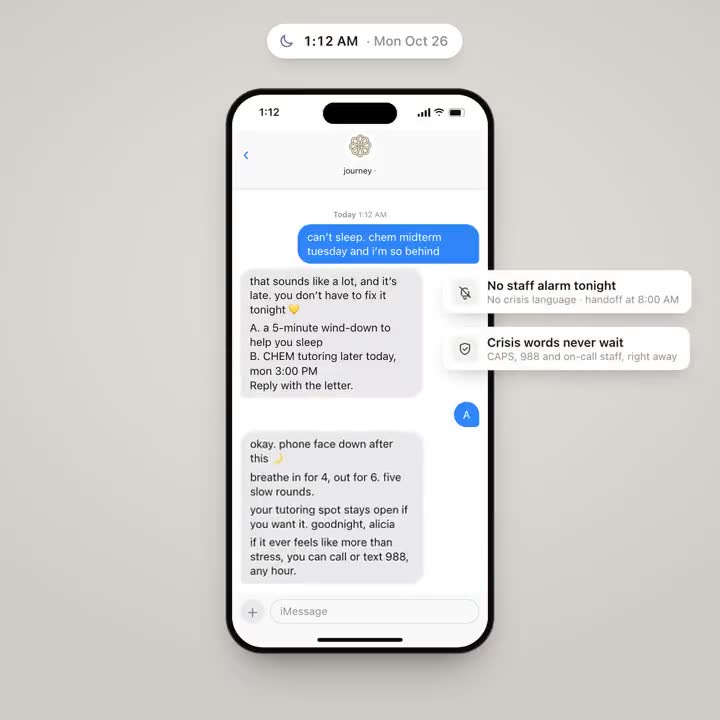
Most late-night texts are not crises. They're stress, insomnia, loneliness and dread about tomorrow. Those deserve a calm reply right away and a daytime option, not a 2 AM page to an exhausted on-call counselor. Crisis language is different: it never waits for morning. The reply points at once to 988 and your campus crisis line, and your on-call staff are alerted under your protocol. Decide in advance which is which, and write down who decides.
What a good late-night reply looks like
Here is the 11:52 PM text again, answered the way we think it should be. No crisis language, so this is support, not escalation.
 Journey
Text Message
Sun 11:52 PM
cant sleep. stats midterm at 9 and i feel sick about it
that's a rough spot the night before. which would help? a) a 2 min wind-down now b) a plan for the morning
a
phone face down after this. breathe in for 4, hold for 4, out for 6. five rounds. you studied, the sleep you get now counts more than one more page.
if tonight ever feels heavier than exam stress, you can call or text 988, any hour. i'll check in after your exam.
Mon 11:20 AM
how'd stats go? a) better than feared b) about as feared c) rough
b, but i finished it
An illustrative thread with a fictional student, showing the shape of a calm reply to late-night stress.
A few choices in that thread are deliberate. The first reply offers two lettered options, so the student decides how much she wants. The exercise is physical and short, because a racing mind at midnight doesn't take advice well. The mention of 988 is one sentence, stated as a fact, not a diagnosis. And the follow-up is scheduled for after the exam, when there's something real to ask about.
What the thread doesn't do matters as much. It doesn't ask her to describe her feelings in depth at midnight, it doesn't interpret her stress, and it doesn't keep her awake with a long conversation.
Questions to settle with your counseling center
Before launch, sit down with the counseling director, or whoever they delegate, for an hour. These are the questions that hour should answer.
- Which words and phrases should route to a person, and who maintains that list?
- Who is alerted during business hours, who after hours, and by what channel?
- What does the first automated reply to safety language say, word for word? Counseling should approve it.
- How soon does a person follow up after an alert, and who records that it happened?
- What can staff outside counseling see about a student's wellbeing, and what stays private?
- What should text support stop short of? Some centers don't want specific coping techniques recommended outside therapy. Ask.
- How will you review misses, false alarms and slow responses, and how often?
Write the answers down in one page that both offices sign. When staff change, the page is still there.
How Journey handles wellbeing texts
Journey texts students first, a few times a week, inside the windows each student chose during onboarding and in the voice they picked. Some of those texts are small resets around the moments the student told us are hard: sleep, exams, the Sunday-night dread. Students can ask anything about campus, including how to see a counselor, and the answers come from the resource base your team set up, with a one-tap link to book.
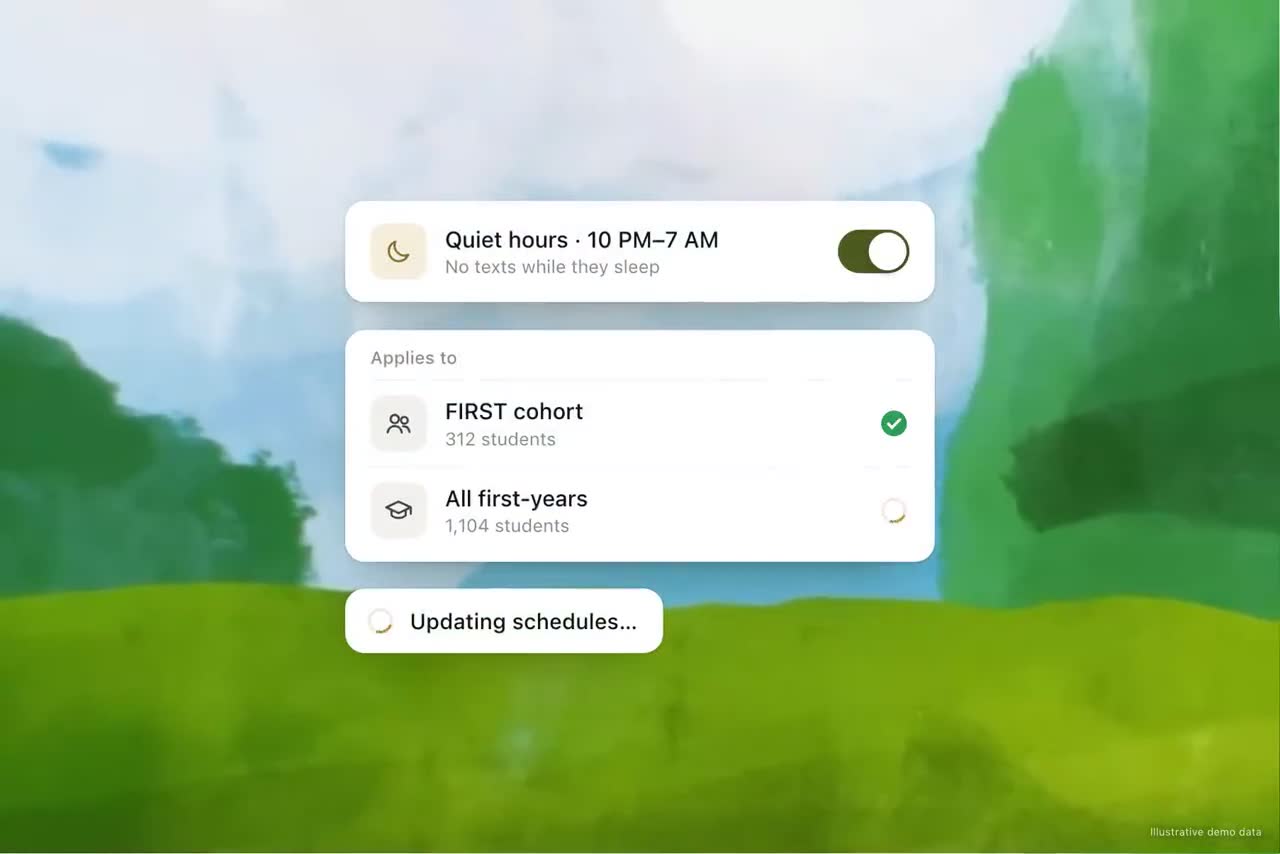
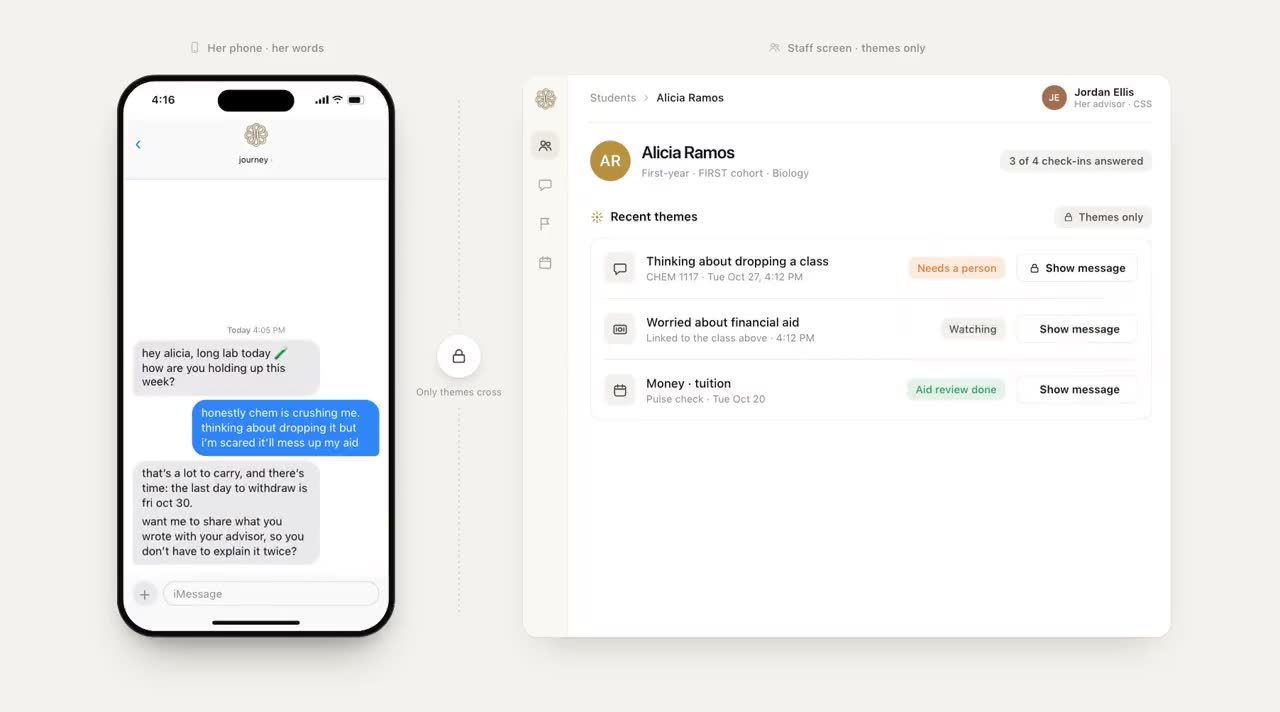
Each reply is read for what it's about and how soon a person should see it. A message that shows a student in crisis gets an immediate reply with 988 and your campus health and wellness contacts, and your team is alerted under the escalation process your campus sets. Signs that a student is struggling alert staff quietly. A student who texts "talk" is told a staff member will reach out as soon as possible. Journey replies to a student up to five times a day and then points them to campus health and wellness, so it doesn't drift into being a late-night companion. The staff dashboard shows a short summary of each student's concerns, not their messages. Quiet hours are honored. Students can text STOP at any time to opt out, or PAUSE to take a week off.
Journey is not a crisis line: when a message raises a safety concern, it surfaces the right human path (counseling, 988, the on-call staff your team names) and follows the escalation process set up with your campus. Journey never replaces a counselor or an advisor. It gets the student to one sooner.
Three safeguards in our product videos aren't live yet: per-message privacy locks the student agrees to, an automatic check that rewrites a sensitive first line before it can reach a lock screen, and a handoff view built for counseling staff. Today, safety language reaches counseling through the escalation process your campus sets with us, and we'll show you exactly what a student sees before anything goes out.
How to start without overreaching
Start narrow. Pick three things text support will do in the first term, such as sleep, exam stress and getting students to counseling, and leave everything else out. Let counseling write the escalation list. Before any student gets a text, run a tabletop test: counseling writes a few dozen sample messages, from "can't sleep" to language that should page someone, and you check what each one triggers and how fast.
Then measure the things that tell you the line is holding:
- Time from safety language to a person. The first reply should be instant. The human contact time should match what your protocol promises.
- Counseling appointments booked from a text link. The clearest sign text is getting students in the door, not keeping them out.
- Opt-outs after wellness texts. If they rise, the tone or the frequency is wrong.
- Review findings. Each month, look at every escalation and a sample of near-misses with counseling. Fix the list, not just the case.
Done carefully, text support doesn't compete with your counselors. It sends them students a little earlier, some with an appointment already booked.
Frequently asked questions
Is it safe to offer student mental health support by text?
It can be, for everyday support such as stress, sleep and getting students to counseling, as long as the boundaries are designed in advance. Text support should never diagnose, counsel or act as a crisis line, and safety language should always reach a person under your campus protocol.
Can an AI text students about mental health?
An AI can send short, supportive texts and help students find and book counseling, but it shouldn't provide therapy. Several states have passed laws restricting AI in mental health care since 2025, so ask your counsel which rules apply to the tools you use.
What should a texting tool do when a student texts at 2 AM?
If the message is stress or sleeplessness, reply right away with something calm and small, offer a daytime option and mention that 988 is there any hour. If it contains crisis language, show 988 and your campus crisis line immediately and alert your on-call staff under your protocol.
How do we protect student privacy on the lock screen?
Keep the first line of any sensitive text neutral, since many phones show it on the lock screen or in a banner. Put counseling, money and grade details inside the thread, where the student sees them only after opening it.
Does texting replace campus counselors?
No. Done well, it gets students to counselors sooner by answering their questions about counseling and making it easy to book. It should never be used to justify a longer waitlist.