Getting First-Years to Office Hours

First-years skip office hours because they don't know what to say, not because they don't care. A playbook built on one email first: the template, when to ask, the texts, what faculty can do and what to measure.
Key takeaways
- What keeps first-years from office hours is mostly uncertainty: what the hours are for, whether they'd be bothering the professor, and what to say.
- Make the first step an email, not a visit. A short template with the course, one specific question and a question about timing turns into a plan.
- Ask right after the first quiz comes back, when the student has a reason to go, and check three days later whether the email went out.
- A professor saying "office hours are for everyone" in class, more than once, does more than any message from another office.
Picture a first-year with a 58 on her first biology quiz. The office hours are on page two of the syllabus. On Wednesday she walks past the open door, sees two upperclassmen already inside and keeps going. She cares about the grade. What she doesn't have is a first sentence.
Most first-years who skip office hours are stuck on that first conversation. After one good visit with a professor, the second is much easier, so getting students to office hours mostly means getting them through the first one. This playbook covers why first-years stay away, the smallest first step that works (an email, not a visit), when to ask, the exact texts, what faculty can do, and how to measure it.
Why first-years skip office hours
The reasons are rarely about time. They're about what students believe office hours are for, and what they're afraid will happen when they get there.
| What the student thinks | What's actually going on | What helps |
|---|---|---|
| "office hours are for students who are failing" | In high school, staying after class often meant you were behind | Say plainly that office hours are for everyone, including students doing fine |
| "i'd be bothering them" | The professor feels important and busy; asking for time feels like asking a favor | Tell them professors hold these hours on purpose and often sit alone through them |
| "i don't know what to say" | No script for a one-on-one conversation with a professor | One specific question and an opening line |
| "do i need an appointment?" | The syllabus lists hours but not how they work | Explain the mechanics: walk in, knock, say your name and class |
| "i have work at 2" | The hours clash with a job, a commute or another class | The email that asks for another time, or a virtual slot |
Four of those five rows are about uncertainty. That's the fixable kind of problem: a script and a plain explanation handle most of it.
Start with an email, not a visit
Walking into an office cold is the hardest version of the task. Sending a short email first makes the visit expected: the professor knows the student's name, the student knows they're welcome, and the first minute of the conversation is already written. Here's a template a student can adapt in two minutes.
Three things make it work. The course and section, so the professor can place them. One specific question, so the visit has a purpose. And a question about timing, which gets a reply and turns the email into a plan. Tell students to send it from their school email, the address professors expect to see.
When to ask
The ask lands when the student has a reason to go. Before the first graded work, the reason is "to introduce yourself", which is fine but easy to put off. Right after the first quiz comes back, the reason is right there on the page.
| Week | Moment | The ask | Owner |
|---|---|---|---|
| 1 to 2 | Syllabus week | Explain what office hours are and how they work. No ask yet | First-year seminar instructors, orientation leaders |
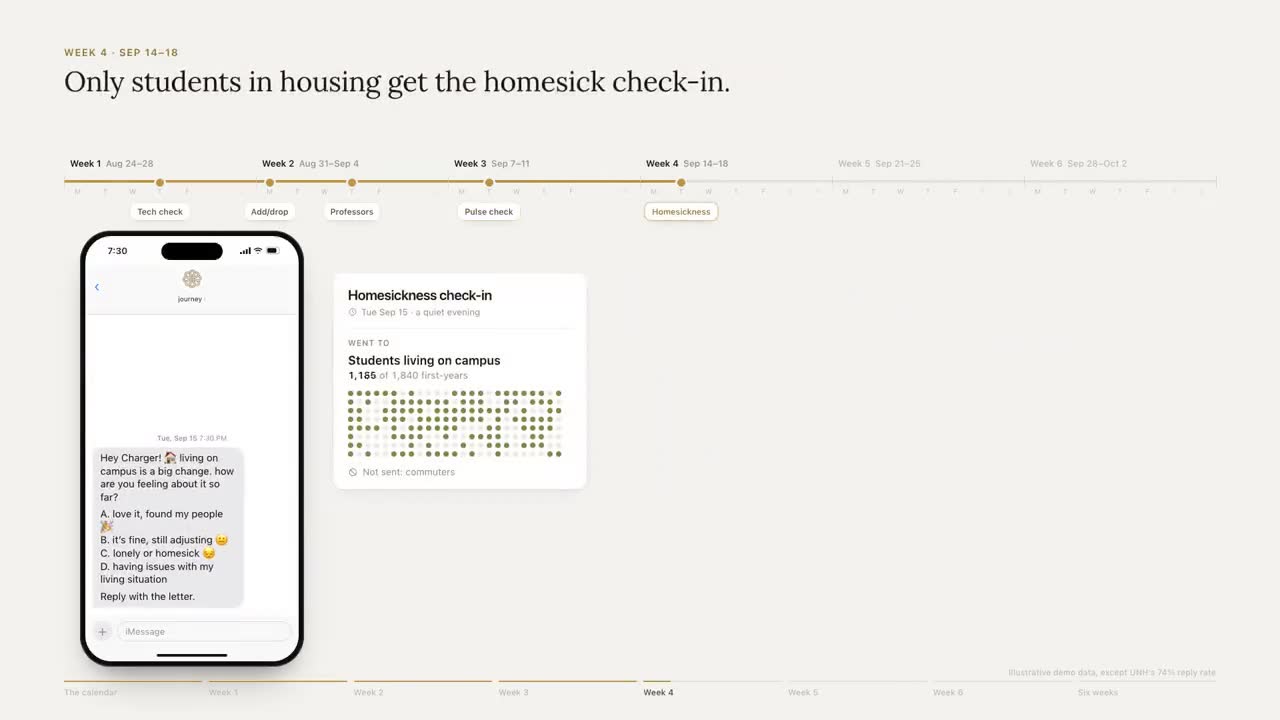
| 3 to 4 | First quiz or problem set returned | Email one professor this week. Just one | Advising or the first-year experience office, by text |
| Any week | Right after the student attends something (a first-gen lunch, a workshop) | "what will you try this week?" with office hours as one of the lettered choices | Whoever ran the event |
| 6 to 7 | Two weeks before midterms | Bring your study plan to office hours and ask what to prioritize | Faculty in gateway courses, plus a text |
| After any low grade | A faculty alert or a grade below the student's goal | A personal invitation from the professor, if they're willing | Faculty, with advising as backup |
Keep one rule: the student hears about office hours a handful of times across the first half of the term, not every week. The week-three ask carries the most weight, so keep other campaigns off the student's phone that week.
The texts, from first ask to follow-through
This is the full sequence for one student, from the week-three ask to the visit. Lettered choices let the student answer with one character, and the template is offered only to students who want it.
 Journey
Text Message
Mon 1:10 PM
quick one: have you talked to any of your professors outside class yet? a) yes, at least one b) no, but i want to c) no, it feels intimidating
c
really normal. professors hold office hours because they want students to come, you're not bothering them. try this: email one professor this week. just one. want a template?
yes pls
here's one. swap in your class and one real question, then send it from your school email.
Thu 4:20 PM
did the email go out? a) sent b) not yet c) changed my mind
a. she said come friday at 1
that's the hard part done. put friday at 1 in your calendar and bring the quiz.
Mon 12:40 PM
how was office hours? a) helpful b) ok c) didn't make it
a. she was actually nice
An illustrative thread with a fictional student: the ask, the template, a check three days later and a check back after the visit. Three unprompted texts across eight days, never more than one a day.
The check three days later is the easiest step to skip. Offering a template is easy; finding out whether the email was sent is what moves a student from "i want to" to a time on Friday. The "changed my mind" option is real too: if a student picks it, the next text asks whether they'd rather talk to an advisor first.
Turn an event into a plan
The best moment to ask for the next small step is right after the student has done one. A first-year who just came to a first-generation student lunch is in a different place than one who hasn't left their room all week. Ask that afternoon: "glad you came. what will you try this week?", with three lettered choices: office hours for one class, the tutoring center, or nothing new yet. A single letter should be enough to put Wednesday's office hours on their week.
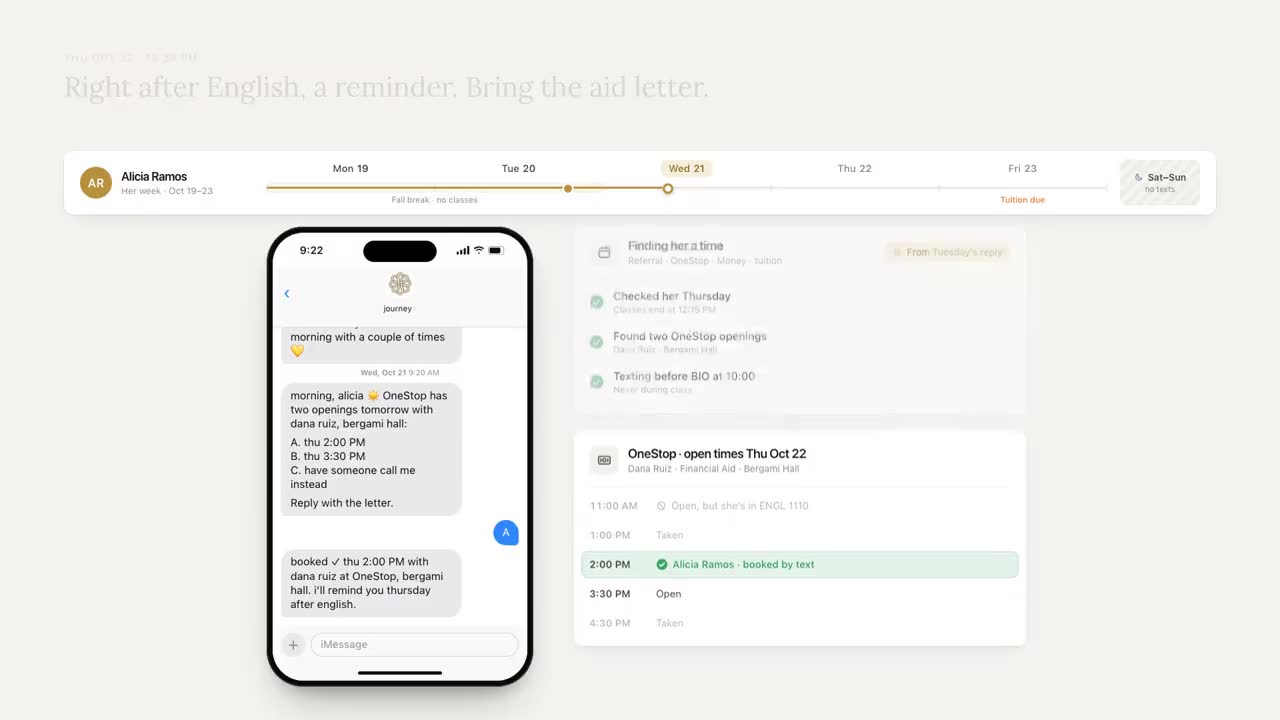
In Journey's demos, that one reply drops Wednesday's office hours into the student's week and onto a plan her advisor can see. Neither the one-reply scheduling nor the staff plan view is live yet; today the reply gets her the time and place to put in her own calendar. The principle needs no particular tool: one step done is the best invitation to the next.
What faculty can do
Most of this playbook runs outside the classroom, but the professor's own words do more than any text. A few small moves, all of which a teaching center or department chair can suggest:
- Say it in class, twice. In week one and again after the first quiz: "office hours are for everyone. come with a question, or just come say hi."
- Rename them. Some faculty call them "student hours" so the purpose is in the name.
- Hold the first one somewhere visible. The hallway outside the lecture hall right after class in week three, so the first visit takes much less nerve.
- Invite by name. One line to a student after a low quiz ("I'd like to go over this with you, come by Wednesday") is the strongest version of the ask.
- Offer one time that works for working students. An evening or virtual slot each week, so a student who has work at 2 can still come.
Journey runs the student side
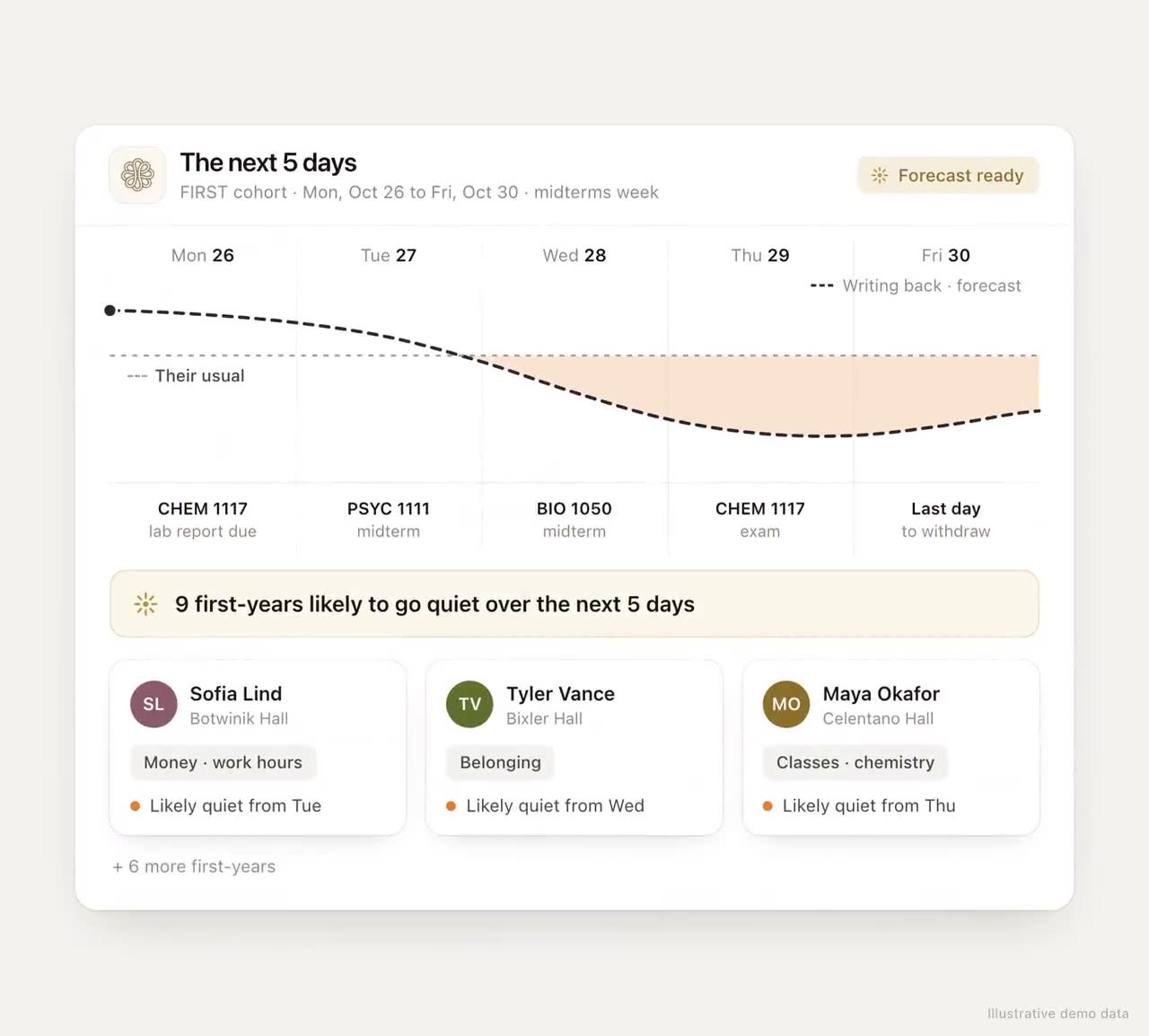
Journey sends the sequence as a campaign: the week-three question with lettered choices, the template for students who want one, the check three days later and the check back after. Students rank their goals when they sign up, so for a student who put grades first, the ask starts from something they already said they wanted. The answer decides the next move: "she was actually nice" closes the step, while "i went but i'm still totally lost in this class" shows up on your team's dashboard as a student who needs a person, so an advisor follows up before the midterm.
In a paired survey of 19 students, the share who said Journey made it easier to do what they already wanted to do rose from 14% in the fall to 71% in the spring. That's the outcome this playbook is after: a student who already wanted to go finds it easier to actually go.
What to measure
- Share of first-years who report talking to a professor outside class by week six. Self-reported, and labeled that way. You can ask it in a two-option text.
- Template requests versus emails sent. If many students ask for the template and few send the email, the template is too long or the check-in comes too late.
- Visits in a sample of gateway courses. Ask a few willing faculty to tally office-hour visitors by week from week three to week eight. It's crude, but it counts visits rather than intentions.
- Reply mix on the first ask. The share who answer "intimidating" tells you how much of the problem is fear, course by course and cohort by cohort.
Resist the temptation to claim grade improvements from office hours visits. Students who choose to go differ from those who don't, and a simple comparison will flatter the program. Report the behavior honestly and let the grade question wait for a proper comparison.
Start with one gateway course
Pick a first-year course with a big enrollment and an early quiz, find one professor willing to say "office hours are for everyone" out loud, and run the sequence from week three to week six. Count the self-reported visits, ask the professor what changed in their office, and decide by midterms whether to add the next course.
Frequently asked questions
Why don't college students go to office hours?
Usually because they're unsure, not unmotivated. Many think office hours are for students who are failing, worry they'd be bothering the professor, or don't know what to say. A script, one specific question and a plain explanation of how office hours work address most of it.
How can professors encourage students to come to office hours?
Say in class that office hours are for everyone, more than once. Some faculty rename them student hours, hold the first one somewhere visible right after class, invite students by name after a low quiz, and offer an evening or virtual time for students who work.
What should a student write in an email to a professor about office hours?
The course and section, a short introduction, one specific thing they want to ask about, and a question about whether the listed time works or another would be better. It should come from the student's school email address.
When is the best time to encourage first-years to go to office hours?
Right after the first graded quiz or problem set comes back, usually in weeks three or four, when the student has a concrete reason to go. A second push about two weeks before midterms also helps.