Emergency Aid: Getting Students to Help They Qualify For

Emergency aid funds often run out of time before they run out of money. How to spot money stress early in students' replies, point each student only to help they qualify for, keep a person deciding, and check back.
Key takeaways
- Emergency aid tends to go unused because students don't know it exists, think it's for someone worse off, or find it after the emergency has done its damage.
- Money stress shows up in replies about classes, work and sleep before it shows up on a form, so ask every first-year how money is going around week four or five.
- Point students only to help they qualify for. A denial for ineligibility teaches a student not to ask again.
- Software can find students and get them to the right office with context, but a person on your staff makes the decision about money.
Many student emergency aid funds run out of time long before they run out of money. A first-year who works at a grocery store has her hours cut in the middle of the term, with rent on her shared apartment due on the first. Her campus has a fund with money in it, a two-page application on the dean of students' website and a committee that meets on Fridays. She has never heard of it. By the time she does, she has picked up a second job, and her chemistry grade is what gives.
A student emergency aid fund pays for an unexpected expense that would otherwise push a student out of school: rent, a car repair, a medical bill, a utility shutoff, a small balance that blocks registration. Many campuses have one, and some have several. The hard part is reaching the students who need it before the emergency does its damage, and pointing each one to help they actually qualify for.
What counts as emergency aid
"Emergency aid" covers several kinds of help, and students rarely know the differences. A typical campus menu looks something like this. Yours will differ in names, amounts and rules.
| Kind of help | Usually for | How fast | Who decides |
|---|---|---|---|
| Emergency grant | A one-time expense that threatens enrollment | Days to a couple of weeks | A small committee or the dean of students |
| Short-term loan | A gap until aid or a paycheck arrives | Often within days | Student accounts or financial aid |
| Completion or retention grant | A small balance blocking registration or graduation | Before the registration window | Financial aid or a retention office |
| Food pantry and meal support | Running short on food, for any reason | Same day | Usually no application at all |
| Emergency housing | Losing housing mid-term | Same day to a few days | The dean of students or housing |
| Aid adjustment | A change in family income, such as a parent's job loss | Weeks | A financial aid counselor, using professional judgment |
The last row isn't a fund at all, but it's often the bigger help. A student whose parent lost a job may qualify for a different aid package than the one they were offered, and an emergency grant can cover the weeks in between.
Why emergency aid funds go unused
- Students don't know the fund exists. It was mentioned at orientation, in week one, alongside forty other things.
- They think it's for someone worse off. "Emergency" sounds like a fire or a hospital. A student skipping meals to make rent often doesn't think that counts.
- The application asks for what they don't have. A landlord's letter, a repair estimate, a bank statement, at 11 PM.
- The timeline is longer than the emergency. A committee that meets every two weeks can't help with rent due Friday.
- The rules are opaque. Students apply to the wrong fund, get turned down, and conclude help isn't for them.
- They get bounced. Financial aid points to the dean of students, who points to the foundation office. Every handoff loses a few students.
Money stress shows up in replies first
Long before a student fills out a form, they say something. "picked up extra shifts." "can't get the book till next week." "my car died." "my mom got laid off." These lines tend to come up in check-ins about classes, sleep or stress, not in conversations about money, and they're the earliest signal you'll get.
So ask. Around week four or five, before midterms, ask every first-year how money is going, with lettered choices that make it easy to say "not great" without explaining. Then follow the reply one level deeper: tuition and fees, day-to-day costs like food and gas, work hours, or family.
Two things make this work. The question goes to everyone, so answering it isn't a confession. And the check back two days later catches the student who tapped the link and gave up halfway through the form. In practice, the exchange can be this short:
 Journey
Text Message
Tue 5:20 PM
quick check. how's money this month? a) fine b) tight but ok c) not great
c
thanks for saying it. what's hitting hardest? a) tuition or fees b) rent or bills c) food, gas, day-to-day stuff d) my work hours got cut
d
that's a lot to carry mid-term. the emergency fund covers things like this, and a real person in the dean's office reads every request. want the link? i'll check back thursday.
An illustrative thread with a fictional student. Everyone gets the first question; only the follow-up depends on the answer.
Offer only what fits, and let a person decide
Sending a student to a fund they aren't eligible for can do more harm than sending nothing. They do the work, get a no, and learn that asking doesn't pay. Next time they won't ask.
So before a student hears about a resource, someone should check that it fits: enrollment status, class year, whether the fund is limited to a program or population, whether they've already received it this year. Some funds were set up by donors for a specific group, such as students in one major, student parents or first-generation students. Your foundation and financial aid offices know these rules. Students don't.
We've made a video of that check done automatically, with Journey comparing a student's record against who each kind of help is for and sending one text about the one that fits. Matching against the student record isn't live. Until it is, and on any campus without it, keep a one-page eligibility sheet for every fund, and have whoever handles money replies check it before pointing a student anywhere.
Make the application fit the emergency
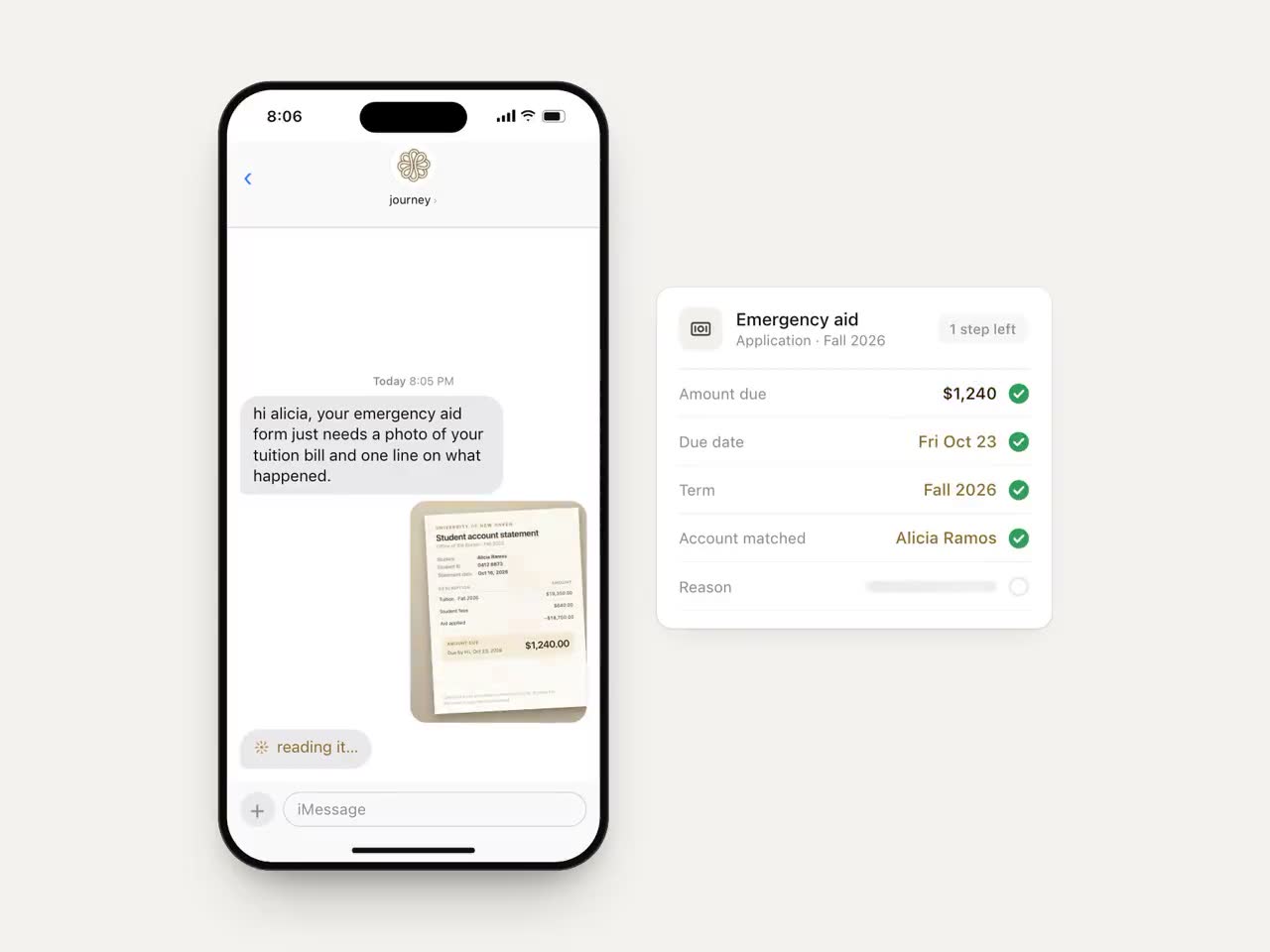
- One short form that works on a phone. What happened, what it costs, when it's due. Documents can follow, or be waived for small amounts.
- Say when they'll hear. "You'll have an answer by Friday" is help in itself.
- Decide on a rolling basis, or at least weekly. A committee calendar shouldn't set the speed of an emergency.
- Name a person. Every applicant should know who to contact if something changes.
- Pay where the problem is. Rent and car repairs need money in the student's bank account; a credit on the student account only helps when the problem is the student account.
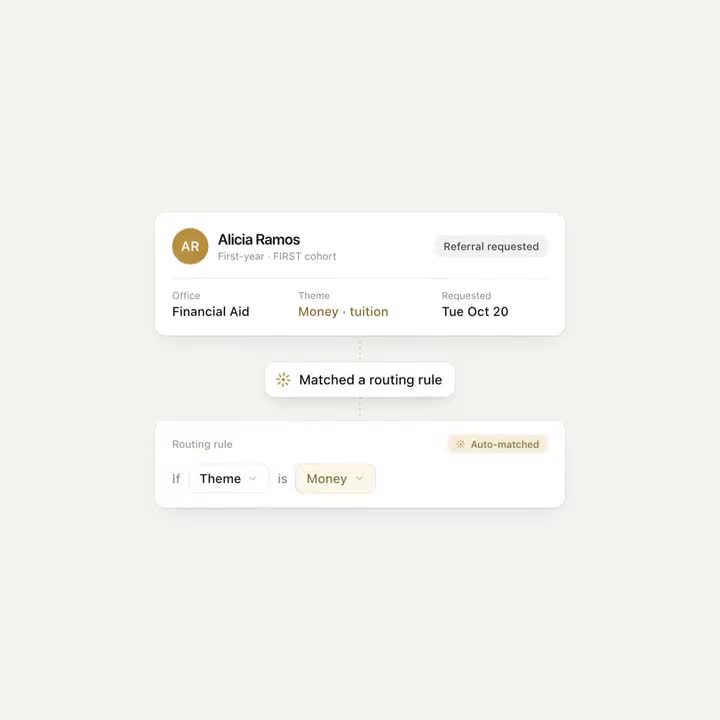
Emergency aid also takes judgment: whether this situation fits, whether a loan or a grant is right, whether there's something bigger behind the request. That decision belongs to a person on your staff. Software can find the students, ask the follow-up questions, narrow the funds that might fit and get the student to the right office with context. It should never be the thing that tells a student no.
The same goes for anything heavier than money. A reply about rent that also mentions not feeling safe at home, or not wanting to be here, is a safety concern first. Journey is not a crisis line: when a message raises a safety concern, it surfaces the right human path (counseling, 988, the on-call staff your team names) and follows the escalation process set up with your campus.
Close the loop on every application
- Two days after the student applies, ask whether it went through and whether they've heard anything.
- When a decision is made, check that the student knows it, and if it's a no, what else might fit.
- A week after the money arrives, ask whether it solved the problem. Rent paid is a fix. Hours still cut is a pattern, and may mean an aid adjustment or a campus job.
- A month later, one light check-in. Emergencies tend to cluster, and a student who needed help once may need a plan.
Asking the money question by text
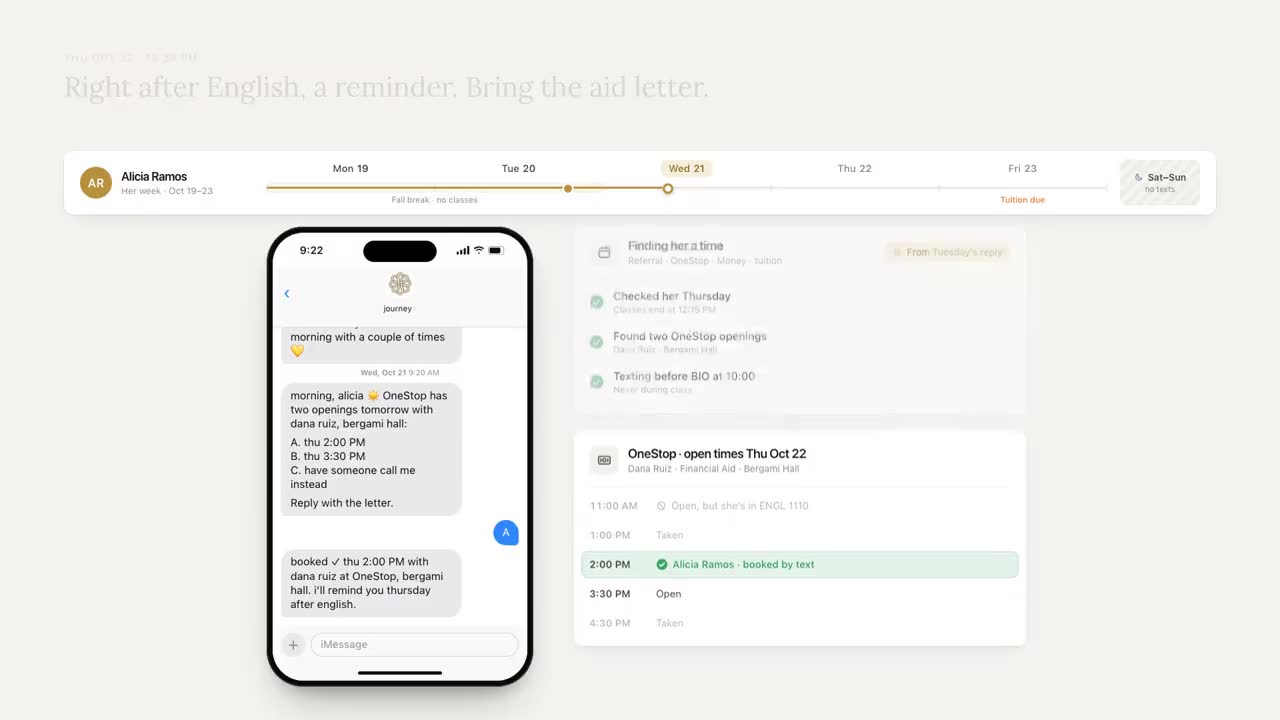
In Journey, the money question goes out as part of a campaign your team schedules. When a reply mentions rent, shifts or a bill, Journey tags it as money, and the student appears on your partner dashboard for a staff member to contact, with the theme rather than the transcript. Journey can text the link to the fund's application or a one-tap link to book financial aid, and a later nudge in the campaign checks back. The decision about money stays with your staff.
In a typical week of the University of New Haven pilot, 74% of students replied to Journey or acted on a nudge. That is the case for asking by text: students answer, so the car, the shifts and the rent come up in a reply rather than on a form they'd never have opened.
What to measure
- Time from first money reply to application. Days, not weeks, is the goal.
- Application completion. Started versus submitted. A big gap means the form is the problem.
- Time to decision and to payment, measured against when the expense was due, not when the application arrived.
- Who applies. Compare applicants with the groups you'd expect to need help. If commuters or first-years are missing, they probably don't know the fund exists.
- Denials for ineligibility. Each one is a student who was pointed to the wrong fund.
- Enrollment the following term for students who received aid, tracked as a check on your own program rather than as a promise.
Start before the next rent cycle
Write the eligibility sheet first: one line per fund on who it's for, how fast it pays and who decides. Then add one money question to a first-year check-in around week five, and name the person who reads every "not great." Before asking donors for more money, find out how many applicants reached the fund before their bill was due, and how many found it after.
Frequently asked questions
What is a student emergency aid fund?
Money a college sets aside for unexpected expenses that threaten a student's ability to stay enrolled, such as rent, a car repair or a medical bill. It can take the form of small grants, short-term loans, completion grants for a final balance, or help like a food pantry or emergency housing. Rules and amounts vary by campus.
Why don't students use emergency aid?
The usual reasons are that they don't know it exists, assume it's for someone in worse shape, or meet an application that asks for documents they don't have on a timeline longer than the emergency. Asking every student early, in plain words, reaches the ones who would never search for it.
How fast should emergency aid be paid?
As fast as the emergency. Rolling decisions, a short form that works on a phone and a stated date for an answer matter more than any single target. A committee that meets every two weeks can't help with rent due Friday.
Should AI decide who gets emergency aid?
No. Software can find students who mention money trouble, ask follow-up questions and get them to the right office with context. Whether a situation qualifies, and whether a grant or a loan fits, is a decision for a person on your staff.
How do you tell students about emergency aid without stigma?
Ask everyone, not only students you suspect are struggling, and make answering easy with lettered choices. Describe the help in plain terms, such as money for an unexpected bill, and name the person who will read the application.