Bringing Stop-Outs Back: Re-Enrollment Outreach That Works

Many stop-outs are waiting on one obstacle, or on someone to ask. A playbook for asking by text whether they're coming back, routing each answer to the office that can clear the way, and timing it around registration.
Key takeaways
- Treat two groups separately: students about to stop out (enrolled, not registered) and those who already have. The first group is cheaper to help and easier to miss.
- Build the list with holds, aid status, standing, credits earned and texting consent, and remove students who enrolled elsewhere.
- Ask one question with lettered answers, then route each answer to the office that can clear the obstacle, with a named owner.
- Start the week registration opens, follow up once, and review every open case across offices weekly until classes start.
- Measure enrollment at census and persistence the following term, not just registrations.
Plenty of stop-outs never decided to leave. They missed a step: a hold over a balance, an aid form, a section that fits a work schedule, a registration window that closed during a double shift. The registrar's list of students who were enrolled last term and haven't registered for the next one is full of them. Some have decided to go. Many are waiting on one thing, or on someone to ask, and by the time classes start the ones who were only waiting have become stop-outs too.
To re-enroll stopped-out students, start with the simplest move there is: ask them, by text, whether they're coming back, with lettered answers, and route each answer to the office that can clear the way. This playbook covers who to contact, the exact texts, routing by reason, timing around registration and what to measure.
Two groups, one question
"Stop-out" covers two groups that need different handling.
- About to stop out. Enrolled now, not registered for next term. They're still on campus, still reachable and still inside every system you have. This is the cheaper group to help, and the easiest one to reach too late.
- Already stopped out. Missed a term or more without graduating or transferring. They're harder to reach, their contact details may be stale, and they may need readmission steps, but some of them are closer to finishing than they think.
The question is the same for both: "are you coming back?" What changes is the timing, the wording, and what has to happen before they can register.
Build the list
Your registrar or institutional research office can usually pull this in a day. For each student, you want:
| Field | Why it matters |
|---|---|
| Last term enrolled, credits earned | A student 15 credits from a degree is a different conversation from one who left after a semester |
| Holds, by type and amount | Often the single thing standing between a student and registration |
| Financial aid status | An unfinished aid application, lapsed eligibility or academic progress appeal |
| Academic standing | Students on suspension need a readmission route, not a registration reminder |
| Enrolled elsewhere | Registrars can often check this; remove students who transferred and send them nothing |
| Contact details and texting consent | Which number, when it was last confirmed, and whether the student agreed to texts |
Why students stop out, and where each reason goes
Stop-outs often aren't about one dramatic event. More often it's an obstacle the student didn't know how to clear, or didn't think was worth clearing alone.
| Reason | What it looks like | Route to |
|---|---|---|
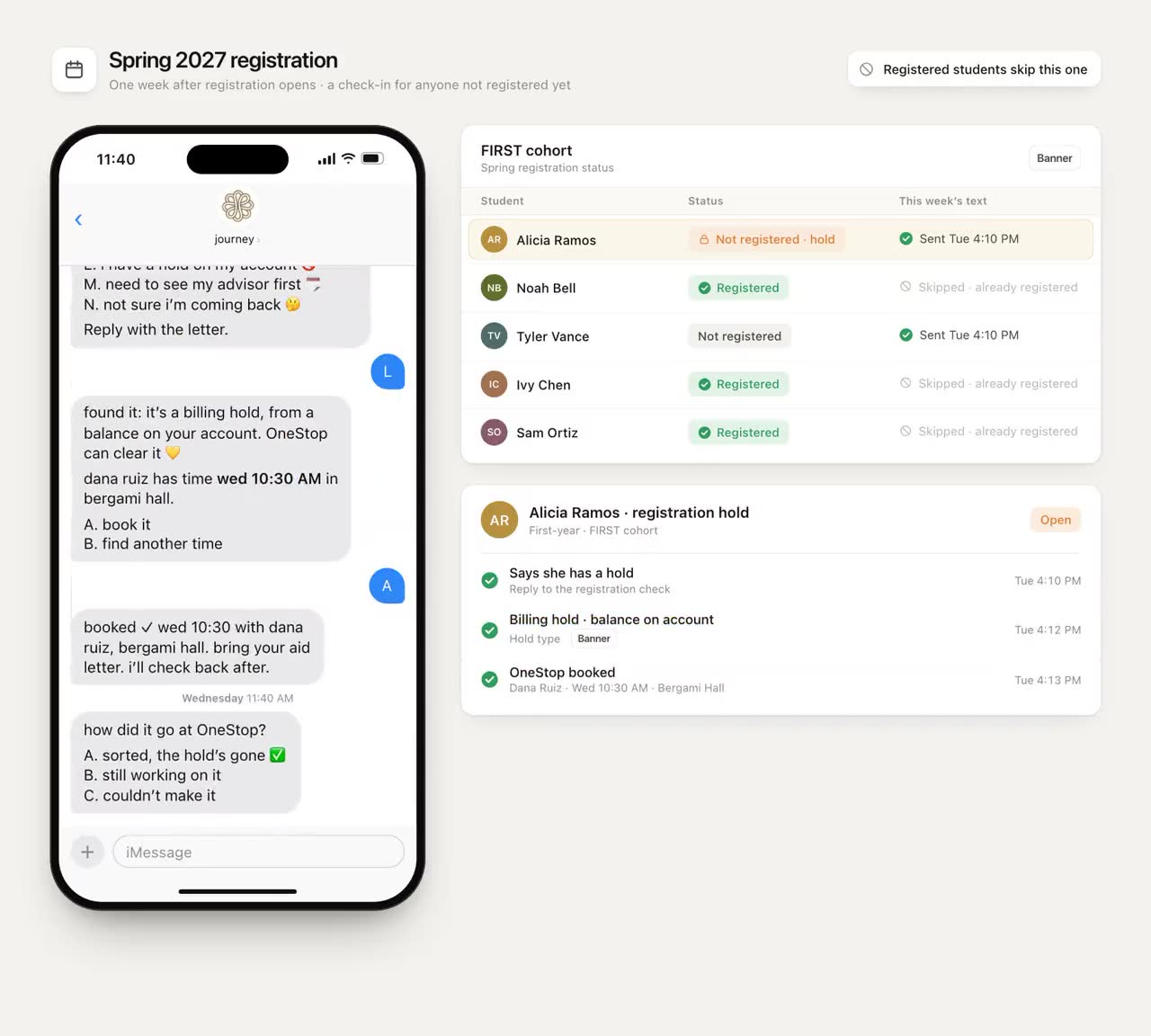
| A hold | A small balance, a missing form, an unpaid fee blocking registration or a transcript | The bursar or one-stop office, with authority to set up a plan |
| Money | Aid didn't renew, the aid application wasn't finished, the gap is too big | A financial aid counselor |
| Schedule | Work hours changed, childcare, a long commute | An advisor who can find evening, online or part-time options |
| Life | Family illness, a move, their own health | The dean of students office or a case manager |
| Academics | Probation, a failed gateway course, a major that stopped making sense | An advisor, and the readmission or appeal process if needed |
| Momentum | Nothing specific; they just didn't register and the window closed | Registration help: a link, a call, a walkthrough |
Some campuses forgive small balances or waive fees for students who come back. If yours does, say so in the first message to anyone with a hold. If it doesn't, the data from this playbook is a good way to make the case for one.
The question, by text
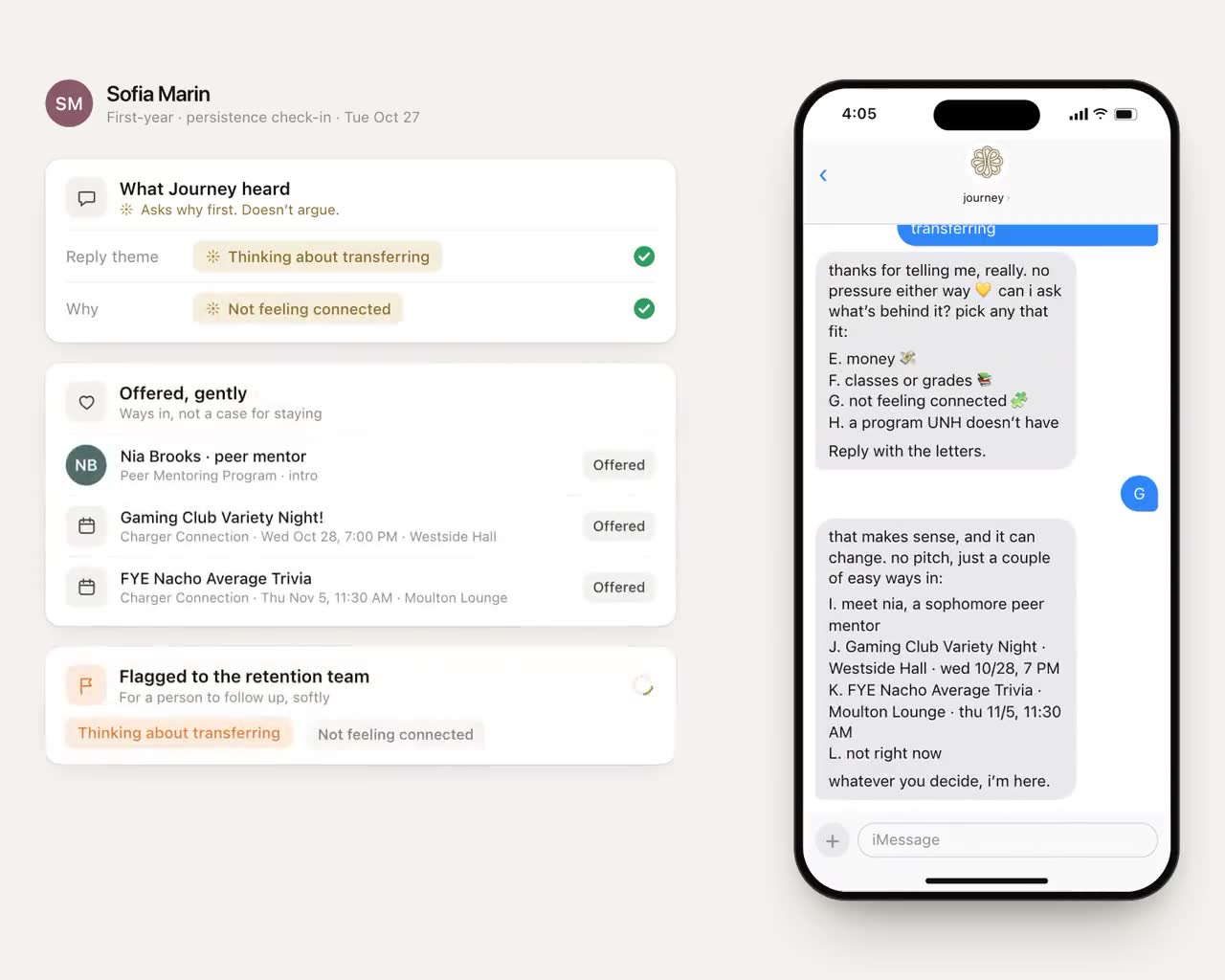
For students who are still enrolled, the question can come from whatever texting relationship they already have. The week registration opens, everyone on the list gets the same question, and students who aren't sure pick their reasons.
 Journey
Text Message
Mon 4:10 PM
registration for next term just opened. are you planning to come back? a) yes, already registered b) yes, but haven't registered yet c) unsure d) probably not
c
thanks for being honest. what's making you unsure? pick all that apply: a) money b) grades c) don't feel connected here d) personal or family e) burnout f) thinking about transferring
a and d
got it, thank you. a real person who can help with both will reach out this week.
An illustrative thread with a fictional student.
For students who have already stopped out, the first message has to do more work. It needs to say who's writing, why, and that there's no catch:
"hi, it's marcus from advising at [university]. you were with us last spring. if you're thinking about coming back, i can help sort out what's in the way. are you?
a) yes, this fall
b) maybe, i have questions
c) not right now
d) i finished somewhere else"
A named person, a reason, four answers that cover most situations, and nothing that sounds like a collections notice.
Route by the answer
Every answer gets a next step, an owner and a follow-up text. The reply decides the route.
| Answer | Next text | Owner |
|---|---|---|
| Yes, registered | "great. see you in january." | None |
| Yes, not registered | "what's in the way? a) a hold b) picking classes c) haven't gotten to it d) something else" | Registration help, or the office named in the answer |
| Unsure or maybe | The reasons question, then "a real person will reach out this week" | Lead owner by reason, assigned within one business day |
| Probably not | "thanks for telling me. can i ask what's behind it?" with the same reasons | Retention coordinator |
| Not right now (former students) | "understood. want me to check in before next term? a) yes b) no" | Retention coordinator keeps a "later" list |
| Finished elsewhere | "congrats, really. we'll update our records." | Registrar marks it; no further outreach |
When a student names a hold, the bursar should reach out with what the hold is for and the options in the same message: "your hold is for an unpaid parking fee. you can clear it with a payment plan starting this month. want me to set it up?" A specific hold with a specific fix is far more likely to get cleared than a line telling the student to contact the bursar.
Timing around registration
The window between registration opening and the first day of class is where this work pays off. Plan backward from your own calendar.
| When | Step | Owner |
|---|---|---|
| Two weeks before registration opens | List built; holds and aid status attached; consent checked | Registrar or institutional research |
| The week registration opens | The question goes to everyone on the list | Retention coordinator |
| One week later | One follow-up to anyone who didn't reply. Only one | Sent automatically |
| Weekly until classes start | Every open case reviewed: reason, owner, last contact, next step | Cross-office huddle |
| Three weeks before the term | Push on holds and unfinished aid, while there's still time to process | Bursar and financial aid |
| The week before classes | Last call, including late-start and online sections | Advising |
| After the census date | Close the list; carry "not right now" students forward | Retention coordinator |
One view across offices
Re-enrollment work fails in the gaps between offices. The bursar clears a hold and doesn't tell advising; advising finds a section and doesn't know about the hold. The fix is one shared list: one row per student, with the reason, the owner, the last contact and the status, reviewed at a weekly huddle with the bursar, financial aid, advising and the retention coordinator in the room.
A shared spreadsheet can do this today. Our demos show a board that every office shares, where each reason lands with the office that can help and gets a named owner before the huddle. That shared board isn't live yet; today the reasons arrive on Journey's partner dashboard and your coordinator keeps the cross-office list.
Asking and routing by text in registration season
For enrolled students, Journey asks the question as a lettered check-in in a campaign scheduled for the week registration opens and records each answer against it. The follow-up asking why can go out the same day, written by Journey and approved by your staff in Slack, and each student who names an obstacle appears on the partner dashboard with that reason as a theme. One-tap links get students to the office that can clear the obstacle, and a student who texts at any point that they're leaving the university triggers a staff notification, so you hear it before the registration list does. Journey keeps to a few texts a week, inside the windows the student chooses even during registration season, so the question doesn't arrive buried under five other messages.
For students who are no longer enrolled, whether Journey can reach them depends on your agreement with us and on the consent they gave, so it's something to settle with your counsel before the pilot. Journey processes student data only under a written agreement with the institution, as a school official with a legitimate educational interest, and SOC 2 certification is in progress.
What to measure
- Reply rate to the question, separately for enrolled and former students.
- Reason mix. If holds dominate, the fix may be a policy change, not more outreach.
- Holds cleared among students who named a hold, and the time it took.
- Time to first human contact for "unsure" and "probably not".
- Enrolled at census, not just registered. A student can register in November and not show in January.
- Persisted the following term. A returning student who leaves again after one term is a sign the original obstacle wasn't really cleared.
Run it first for the students who are about to stop out: enrolled now, not yet registered. They're the easiest to reach and the cheapest to help, and the reasons they give will tell you what to fix before you go after the students who already left.
Frequently asked questions
How do you re-enroll students who stopped out?
Build a list of students who left without graduating or transferring, attach their holds, aid status and standing, and ask them by text whether they're coming back, with a few lettered answers. Route each answer to the office that can clear the obstacle and give every case a named owner.
Why do college students stop out?
Common reasons include holds over balances or missing forms, aid that didn't renew, work and family schedules, health or family events, academic standing, and simply missing the registration window. Many are waiting on a single obstacle.
When should re-enrollment outreach start?
Build the list a couple of weeks before registration opens and send the first question the week it opens. Follow up once with students who didn't reply, push on holds and aid about three weeks before the term, and send a last call the week before classes.
Can colleges text students who are no longer enrolled?
Consent and privacy rules still apply after a student stops enrolling. Check with your counsel how the student's consent was given and whether it covers this outreach, identify the sender in every message, and honor STOP immediately. This is general information, not legal advice.