Published:
Journey Holistic Well-Being Framework
Everyone says holistic. Here is what it means: eight parts of a student's life, three ways to read each, and the rule that keeps them apart.
 Journey team
Journey's holistic well-being framework: eight dimensions of a student's life (social, learning, career, financial, spiritual, emotional, physical, mental) around awareness, read three ways: how they feel, how they judge their life, what they do.
Everyone says holistic. Few show what it means.
A student is a whole person. They need different support at different times, in different parts of their life: school, money, sleep, friends, a future they can picture. We call those parts spheres. A student can be fine in one and drowning in another, and a single score hides which. This is the framework behind Journey, and what it looks like in a week.
Well-being has parts
Higher-ed research measures it across several dimensions. One recent scale for students uses five: academic, financial, physical, psychological resilience and relational well-being. The American College Health Association looks at areas like belonging, life satisfaction, coping, academic engagement, loneliness and purpose. ASU ties mental, emotional and physical well-being to how students do in class, and uses its own survey results to guide faculty.
They don't agree on every part. They agree it has parts.
Three ways to read a student
Kahneman and Krueger give us the distinction we lean on most. How someone feels in a moment and how they judge their life looking back are related, but they are not the same measurement. And people answer more accurately about a specific moment, asked soon after it happened.
We add a third: what they do. ACHA keeps outcomes apart from the pathways that lead to them, and so do we. A student can show up to everything and still feel they don't belong.
One
How they feelOne moment, soon after it happened.
A short pulse question about today, answered in one tap.
Two
How they judge their lifeThe term so far, looking back.
The same few questions, asked at the start and again later.
Three
What they doWhat actually happened.
Only what a student confirms or an office records.
Eight spheres, one person
Here is how we draw it. Eight spheres of a student's life, each read three ways, around the one thing we add on purpose: awareness. Point at any of them on the wheel above.
Social
Belonging, and who they can text at 11 PM.
- Feels
- Felt left out today?
- Judges
- I fit in here.
- Does
- An event attended, a club joined.
Learning
Whether school feels doable.
- Feels
- How today's class felt.
- Judges
- On track this term.
- Does
- A study block done, an advising visit kept.
Career
A future they can picture.
- Feels
- How a career step felt.
- Judges
- Goals they care about.
- Does
- A career center appointment.
Financial
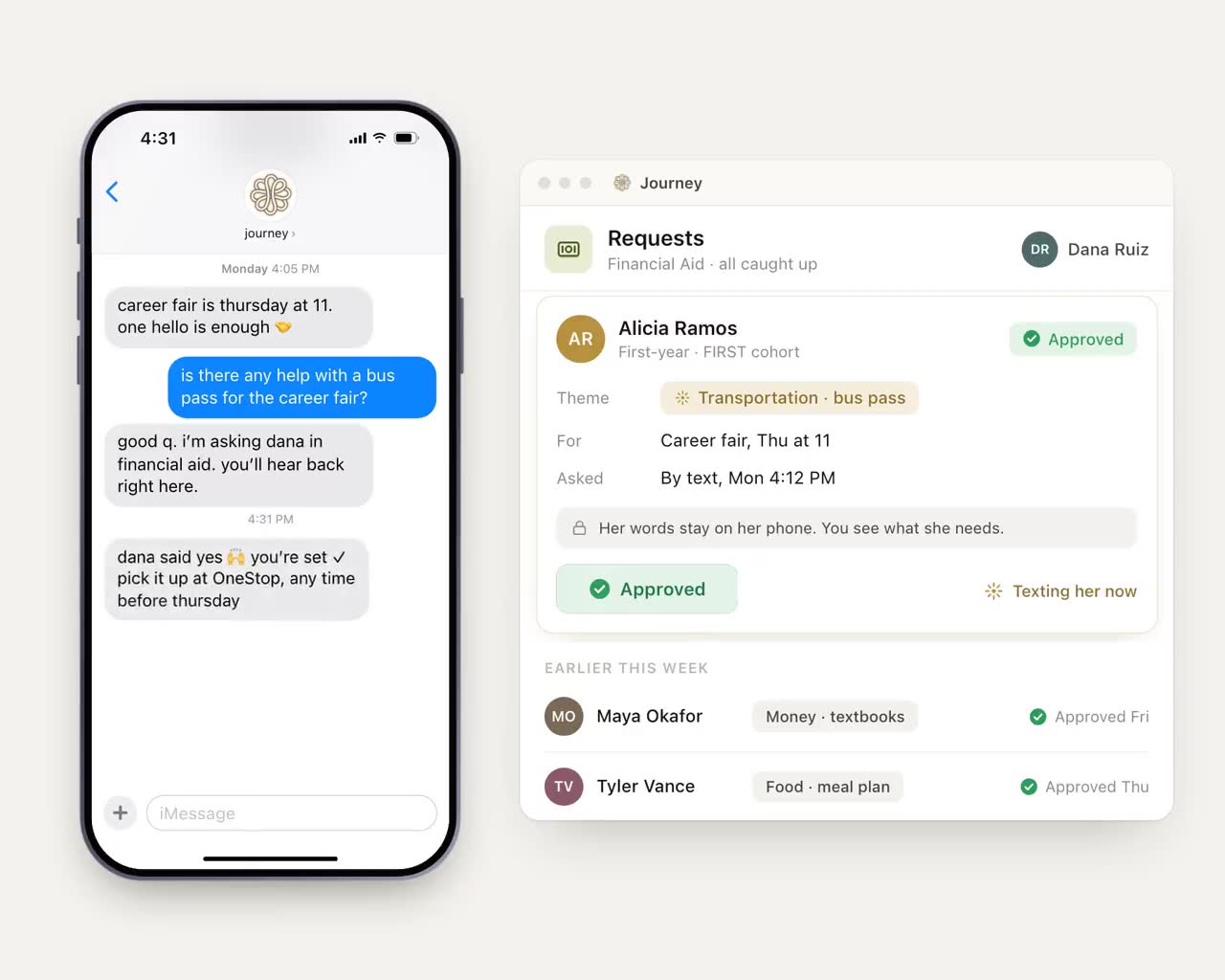
Money stress, a hold, the bus pass.
- Feels
- Money worry this week.
- Judges
- Can cover this term.
- Does
- An aid or basic-needs connection.
Spiritual
Meaning and purpose, religious or not.
- Feels
- Did something worthwhile today?
- Judges
- My days feel worthwhile.
- Does
- Time in a community they chose.
Emotional
How a bad day lands, and how they bounce back.
- Feels
- The strongest feeling today.
- Judges
- Satisfied with life lately.
- Does
- A reset they tried.
Physical
Sleep, food, movement, screens.
- Feels
- Slept enough? Energy today.
- Judges
- Satisfied with sleep and health.
- Does
- A workout, a health services visit.
Mental
Stress, worry and coping. Never a diagnosis.
- Feels
- How stressed today feels.
- Judges
- Can get through a hard week.
- Does
- A counseling visit kept.
Awareness
A student seeing their own pattern.
Awareness is ours, not a research scale: a student noticing how they feel, what they want and where to get help. It isn't about judgment. You can't level up what you don't acknowledge.
Not every sphere gets a number. Some only show up when a student brings them up, like a money worry. A missing number isn't a zero.
Start with one sphere
The spheres aren't separate. Push one and the others move. Typically it's social belonging and mental health: once those are nurtured, the rest follow.
But the first domino isn't the same for every student. Here is where each of our five types tends to start.
Pathfinder
Do first Two work blocks a week and one check-in.
- Academic structureLearning
- Anxiety dropsMental
- Belonging liftsSocial
- Health steadiesPhysical
Watch for Feeling stuck, with no progress they can see.
Explorer
Do first Seven hours of sleep, a daily walk and one active event.
- Sleep and movement rhythmPhysical
- Focus returnsLearning
- Joins active plansSocial
- Mood liftsEmotional
Watch for Boredom, drift and irregular sleep.
Connector
Do first One event and one study pod. Say no to extras.
- Belonging with boundariesSocial
- Less overloadMental
- A steady study rhythmLearning
- Better healthPhysical
Watch for Burnout from saying yes to everything.
Creator
Do first A weekly show-your-work circle and two small deadlines.
- A creative outletEmotional
- Self-regulationMental
- Small deadlines metLearning
- Joins a small groupSocial
Watch for Perfectionism, and struggling in private.
The rule: keep them apart
The spheres move together. That's exactly why you count them apart: blend them into one number and you can't see which one moved first. Five rules keep it honest.
- Never let one number stand alone.A score is a summary. Always show the spheres underneath it.
- Read the three side by side.How a student feels, judges and acts, together. The signal is a mismatch: busy, but lonely.
- Treat silence as missing data.A student who didn't answer hasn't scored low. They haven't answered.
- Make every number say where it came from.A quiz, a pulse, a reply, a confirmed action or an office's record.
- Send danger to a person.A reply that sounds like a safety concern goes to a human, never a nudge.
A week, in practice
Here is what holistic looks like when it's working. One student, one week, a few spheres at once, and the moment a person steps in.
pulse check. how's the week landing? a) good b) fine c) rough
JourneyMon 8:14 PMFeelsMentalLearningc. calc midterm thursday
 A first-year PathfinderMon 8:16 PMFeelsLearning
one move tonight: bed by 11, then 20 minutes on the part you skipped.
JourneyTue 7:30 AMDoesPhysicalLearningdid it. in bed by 11:30
A first-year PathfinderWed 9:02 PMDoesPhysicalQuiet since the midterm. At intake she said she doesn't know how to ask for help.
JourneyThuJudgesEmotionalSocialwant me to loop in your advisor? just a check-in, nothing more.
JourneyThu 6:40 PMSocialA personok yes
A first-year PathfinderThu 6:52 PMSocialHer advisor gets the status, never the substance. Fifteen minutes, in person. She came.
Her advisorFri 2:00 PMDoesLearningSocialA person
Next week changes: fewer reminders, one study pod invite on Tuesday evening.
JourneySunLearningSocialLearns
She did the work. Journey just made the next step a little easier.
Where AI stops and a person starts
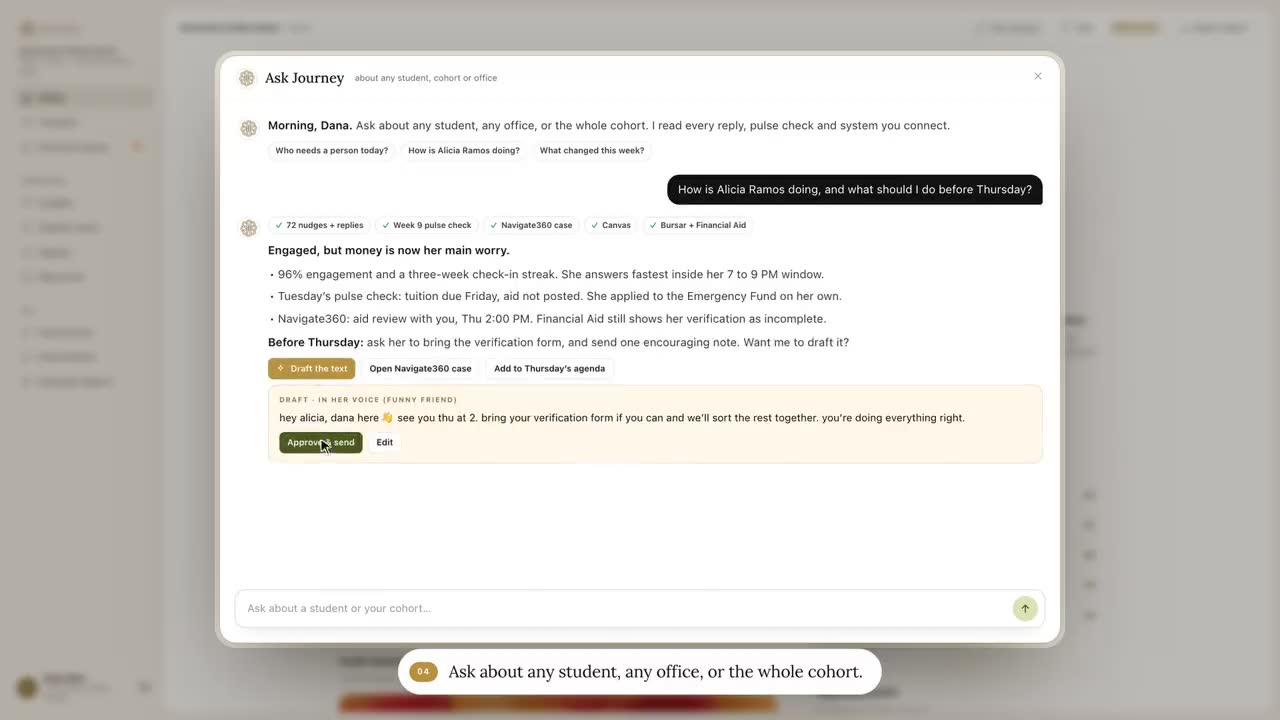
AI does the listening. Humans still do the helping. Journey reads the signals and drafts the texts; people make the calls that matter. When the three readings stop matching, or a student goes quiet after telling us they don't know how to ask for help, Journey asks first, then brings in a person.
Journey doesn't pretend to solve financial aid. It turns the fear into a question, gets the student to the right office, and then comes back. Our AI principles say where that line sits.
The research behind it
Hear it from the people who use it
 BenStudent, University of New HavenBen, a student at the University of New Haven, on why a text from Journey feels like doing something for himself.Watch, 2 min
 JadeStudent Success Team, University of New HavenJade, on the student success team at the University of New Haven, on what Journey's reports showed her about students and the mentors who support them.Watch, 2 min
 OpheliaDean of Students, University of New HavenOphelia, Dean of Students at the University of New Haven, on retention, the holistic picture, and sharing what each side sees.Watch, 2 min
Well-being isn't one number. A student can feel fine today, be unhappy with how the year is going, and still show up to everything. We count what students do apart from how they say they are, so a full calendar never hides a lonely student. When those stories stop matching, a person reaches out.
And the student sees it too. That's the point. You can't level up what you don't acknowledge.
We build Journey with the student success teams who use it.