Supporting First-Generation College Students Through the First Year

First-generation students aren't missing ability. They're missing the unwritten rules nobody hands out. How to make the hidden curriculum visible, make asking cheap, and fit first-year support around work.
Key takeaways
- Much of what trips up first-generation students is the hidden curriculum: terms like office hours, bursar and credit balance that nobody explains.
- Explain each term again at the moment it matters, such as credit balances when refunds go out and holds before registration.
- Make asking cheap: questions by text whenever they come up, answered without judgment, with what to bring.
- Fit support around work with evening and online options and nudges timed to the student's free moments, and leave work nights quiet.
"Office hours" sounds like the hours the office is open. Plenty of first-year students read it exactly that way, and never go. Nobody told them it means a professor sitting in a room waiting for students to drop in with questions, or that going is a normal part of doing well, not a sign of trouble.
That's the hidden curriculum: the unwritten rules of college that students with a college-educated parent often pick up at the dinner table, and first-generation students have to work out alone. Supporting first-generation college students through the first year is mostly a matter of making that curriculum visible, making it cheap to ask about, and fitting help around the jobs and family responsibilities many of them carry.
First, the definition. Most campuses use some version of "neither parent completed a four-year degree," though definitions vary, and some treat a parent's degree from another country or a degree finished later in life differently. Many identify first-gen students from the admissions application and also let students self-identify. Whatever definition you use, publish it, so students know your first-gen programs are meant for them.
Be clear, too, about what first-gen doesn't mean. First-generation students arrive with plenty: work experience, responsibility, often a reason for being here that's bigger than themselves. What they're missing is information nobody handed them, and that is a gap a campus can close.
The hidden curriculum of the first year
| Term | What a first-year might think | What it means | Who to ask |
|---|---|---|---|
| Office hours | When the office is open | Time a professor sets aside for students to drop in | The professor; it's on the syllabus |
| Syllabus | A list of topics | The rules of the course: grading, deadlines, policies | The professor |
| Bursar | No idea | The office that bills tuition and fees, sometimes called student accounts | Student accounts, or a one-stop office |
| Credit balance | Money they owe | Money the school owes them, often aid beyond the bill | Student accounts |
| Registration hold | Something is wrong with them | A block on registering until a balance, form or meeting is handled | The office named on the hold |
| Drop versus withdraw | The same thing | Dropping early usually leaves no record; withdrawing later usually leaves a W | The registrar or an advisor |
| Academic probation | Being kicked out | A warning, with a plan and a chance to recover | An advisor |
| Prerequisite | A suggestion | A course you have to pass first | An advisor |
| Work-study | A job they're assigned | Aid they earn by finding a qualifying job, usually on campus | Financial aid or the career center |
| Advisor and professor | Interchangeable | The advisor helps plan the degree; the professor teaches the course | Either can point to the other |
Orientation mentions nearly every row once. This table is the case for mentioning each one again at the moment it matters: credit balances when refunds go out, holds a month before registration, withdrawal the week before the deadline.
Why first-generation students don't ask
- Asking feels like proof. Proof that they don't belong, that everyone else already knows.
- They don't know what to ask. You can't ask about a credit balance if you think it's a bill.
- Home can't answer. Parents who would help in a heartbeat may not know what a bursar is either.
- Help is open when they're at work. Office hours at 2 PM don't work for a student on a 1-to-9 shift.
- They don't want to be a burden. Many are the person their family turns to for help, and less practiced at asking for it.
Here is how one of those questions sounded in a real thread, in October.
 Journey
Text Message
question about the bursar. there's money sitting on my account and i don't get it
what's the bursar piece? a) refund timing b) an amount that looks off c) something else
c. it says credit balance. i think it happened last year too
so you've got a credit balance sitting there. ask them to issue the refund, not just leave it on the account. one stop can help too.
sorry if that's a dumb question
not dumb, nobody explains that stuff. bring the statements for each semester it happened so you can ask about all of them at once.
A real Journey thread, shortened, with details changed so the student can't be identified.
The line that matters is "sorry if that's a dumb question." It sits underneath a lot of first-gen help-seeking, and the answer to it ("not dumb, nobody explains that stuff") does as much work as the bursar information. Notice, too, that the student thought it had happened the year before. A question that took a minute to ask had probably gone unasked for a year.
Make asking cheap
- Let students ask by text, whenever the question comes up. Questions come up when a student is staring at the account page, which is rarely during office hours.
- Answer without judgment, every time. "a lot of students ask this" as a first line does real work.
- Say what to bring. "bring the statements for each semester" turns a vague visit into a short one.
- Make first-gen staff visible. Faculty and staff who were first-gen and say so, on a door or in an email signature, show students that people like them made it through.
- Bring families in, in their language. A family session or a short translated guide helps parents help.
Fit support around work
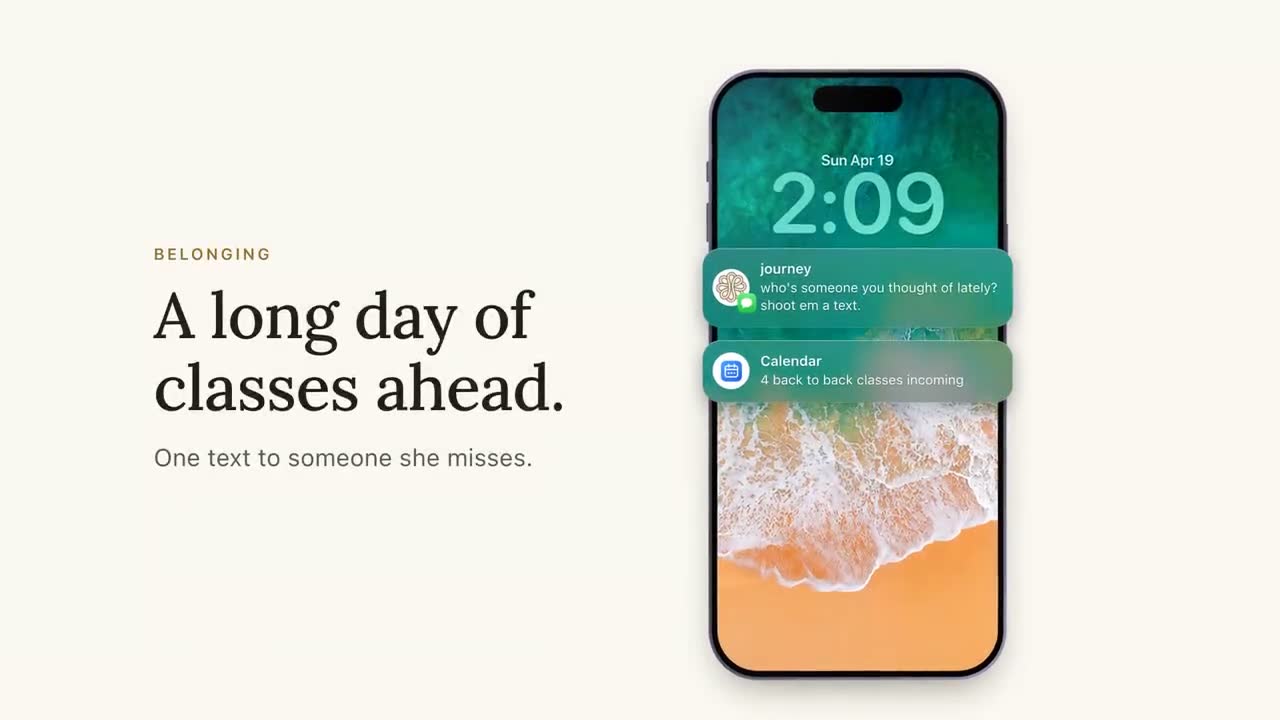
Many first-generation students work, some close to full-time, and some help support their families. Support that only exists from 9 to 4 misses them. Offer evening and online tutoring, early-morning advising slots, and nudges timed to when the student has a moment, not when the office does.
Working students also need help choosing what to do first. When everything is due, a message that names one thing is a relief. From a real thread in January:
JourneyText Message
i have math homework and my RA interview prep and i keep switching between them
math first so it's off your list, then shift fully to interview prep. want to set time blocks for today?
yeah
timer on for focused math, then interview prep. what's the first math topic?
sets. union and intersection
start with set notation and the basic operations. if you get stuck, do a few practice problems.
A real Journey thread, shortened, with details changed so the student can't be identified.
One thing first, then the next, with a timer. It's a small move, and a student who keeps switching between tasks often can't make it alone.
A week in a first-gen student's semester
Alicia is fictional: a first-year in a first-generation cohort who works three nights a week. Here is one week of her fall, and where support fits into it. It's illustrative.
| Day | What's going on | Where support fits |
|---|---|---|
| Monday | Back from fall break to an 8 AM lab, after a weekend of shifts | A short check-in on how the week looks |
| Tuesday | Sees "credit balance" on her account and assumes it's a bill | A plain answer by text, and a booking link for One Stop with what to bring |
| Wednesday | Works 5 to 11 | Nothing. It's a work night, and she said so in onboarding. |
| Thursday | Chemistry office hours, which she has never been to | A nudge an hour before, with one question worth asking |
| Friday | A scholarship workshop she picked during onboarding | A reminder in her window, with the room |
| Weekend | Shifts both days | Quiet |
Look at the quiet days. Support that respects a work schedule is support a working student keeps answering.
Programs that help
- TRIO Student Support Services, if your campus has a program, serves first-generation and low-income students, and students with disabilities, with advising, tutoring and more.
- A first-gen center or office, even a small one, gives students a door with their name on it.
- Peer mentors who were first-gen, a year or two ahead, who remember what confused them.
- Summer bridge programs, which teach the hidden curriculum before the first day.
- First-year cohorts, so first-gen students meet others in the same position early.
Answering the questions nobody explains
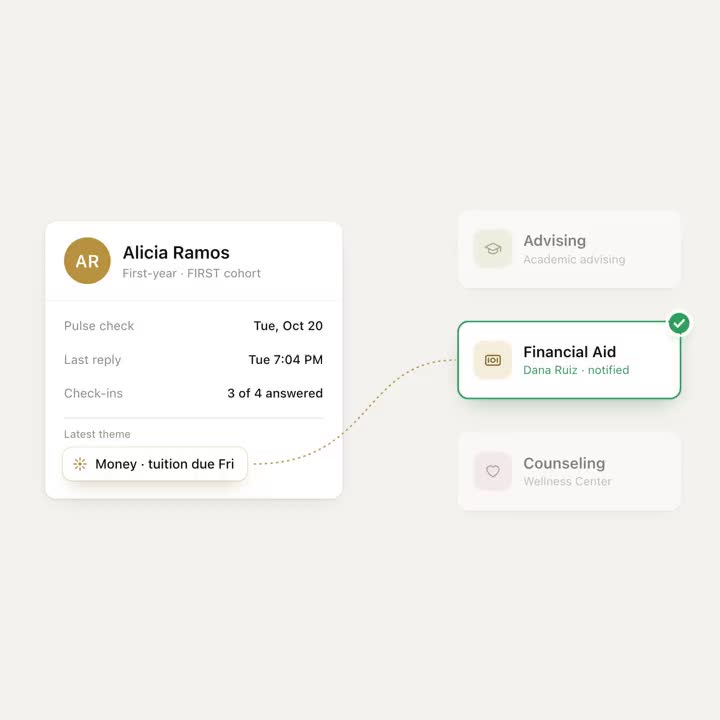
Journey gives students a low-stakes place to ask. They text questions about campus and get answers from your campus resource base, in plain words, and when Journey doesn't know, it says so and points to a person. Onboarding takes about 90 seconds: students rank their goals, pick the events they care about and choose the voice Journey texts them in. Nudges arrive in the windows they choose, so a student who works nights isn't texted on work nights. Your first-gen program staff see the topics each student keeps returning to (money, work, a hard course) on the dashboard, without opening the messages. Booking a one-stop office or an advisor is a one-tap link.
Two things in our video of Alicia's week aren't live yet: booking her into One Stop by text, and pulling events from a live campus feed. Fitting texts around her classes is live in one form. If she texts a screenshot of her class timetable, no nudge reaches her during a class, and she can change the rest by plain text, such as "only 2 nudges a week" when her shifts pile up. Importing schedules straight from your systems isn't live, and today she books One Stop through a link.
What to measure
- The questions first-gen students ask, by theme. They're a map of what orientation didn't land.
- First visit to office hours, by week of term. Earlier is better.
- Holds and unclaimed credit balances among first-gen students at the start of each term.
- Tutoring and advising use by time of day. If first-gen students only show up in the evening slots, you need more of them.
- First-to-second-term persistence for first-gen and continuing-generation students, from your institutional research office.
Start with the questions
Ask your first-gen staff for the ten questions they hear most in the first six weeks. Write a plain answer to each, with who to ask and what to bring, and send each one in the week it usually comes up instead of all at orientation. Then keep a running list of the questions students text that weren't on it, and add them next term.
Frequently asked questions
What is a first-generation college student?
Most colleges use some version of a student whose parents didn't complete a four-year degree. Definitions vary by campus, so publish yours, and let students self-identify so they know your first-gen programs are meant for them.
What is the hidden curriculum in college?
The unwritten rules and vocabulary of college that students are expected to know but are rarely taught: what office hours are for, what a bursar does, what a credit balance or a registration hold means. Students whose parents went to college often learn them at home.
What do first-generation students struggle with most in the first year?
Often not the coursework itself, but knowing what to ask and feeling able to ask it, alongside work and family responsibilities. Small things like an unexplained hold or a misread credit balance can become real problems if nobody explains them.
How can advisors support first-generation students?
Explain terms at the moment they matter rather than once at orientation, treat every question as a normal one, say what to bring to each office, and offer times that fit around work. Advisors who were first-gen themselves can say so.
How do colleges identify first-generation students?
Many use the admissions application, which typically asks about parents' education, and also let students self-identify. Check that the definition you use matches the one your first-gen programs use.