Raising Tutoring Center Use Without Another Email

The students who need tutoring most tend to arrive in finals week. A playbook for reaching them after the first quiz instead: free help first, one-tap booking, a check back, faculty partners and what to report.
Key takeaways
- Time the ask to graded work, not the calendar. The week the first quiz comes back is the strongest moment to offer tutoring.
- Lead with free help, named for the student's course with a day, time and room. Some struggling students don't know the campus offers it.
- Make booking one tap and check back after the session. A standing weekly slot turns a single visit into a routine.
- Report unique students, first-time visitors in weeks three to six and second visits, not total visits.
Ask a tutoring center director to describe their semester and you'll often hear the same shape. Week three, the tutors outnumber the students. Week fourteen, there's a line out the door, and a good share of the people in it have been lost since the first quiz. The help was there the whole time. It just wasn't there at the moment those students knew they needed it.
Raising tutoring center usage is mostly a question of timing. Reach the right students in the week their need is visible, offer free help in a form they can picture, make booking one tap, and check back afterward. This playbook covers each step, with timing, texts, owners and what to report.
Why students who need tutoring don't go
The students who use tutoring early are often the ones doing fine. The ones who are struggling hold back for reasons that are easy to name and, mostly, easy to address.
| Reason | What it sounds like | What helps |
|---|---|---|
| Stigma | "tutoring is for people who are failing" | Frame it as what strong students do, and invite whole sections, not just flagged students |
| Not knowing it's free | "i was going to look for a tutor online" | Lead every message with "free" and the exact course |
| Not knowing they're behind | "i thought i'd catch up before the midterm" | Ask right after the first graded work, when the gap is visible |
| Booking friction | Another portal, another login, a form asking for a course code | A link that opens to that course's slots |
| Fear of the first visit | "what do i even bring?" | Say what happens in the first ten minutes, and what to bring |
| Time | Work shifts, a commute, labs in the afternoon | Name the evening and online options in the same message |
Time the ask to the course, not the calendar
A lot of tutoring promotion runs on the academic calendar: a welcome-week table, a midterm reminder, a finals push. The need runs on the course. In chemistry it shows up after the first problem set. In a writing course it shows up when the first draft comes back. So the most useful moments are tied to graded work.
| Week | Moment | The ask | Owner |
|---|---|---|---|
| 1 to 2 | Start of term | Name the session for their course, day and time. No pressure to book yet | Tutoring center director supplies the course schedule |
| 3 to 4 | First quiz or problem set returned | The main ask: "how'd it land?" with tutoring offered to anyone who says ok or rough | Advising or first-year office sends; faculty post grades on time |
| Any week | A faculty early alert for that course | A same-day text with the course's tutoring link | The alert owner |
| 5 to 6 | Two weeks before the first midterm | "two weeks out, not two days." The review session and a regular slot | Tutoring center, with faculty announcing it in class |
| After midterm grades | A low midterm | A plan for the second half: a weekly slot, not a one-off | Advisor, with the tutoring center |
| 13 to 15 | Finals | Group review sessions, booked a week ahead | Tutoring center |
If you only have the staff time for one of these, make it week three or four. A student who comes in after the first quiz has ten weeks to use what they learn. A student who comes in during finals has days.
Free help first
Some students who are struggling pay for help, or plan to, while the campus offers it free. Some don't know. Some assume free means worse. Some only know about the private tutor a roommate used last year. Whenever you offer help, put the free options first and make them concrete.
- The tutoring center session for their course, with the day, time and room.
- Peer-led review sessions, if your campus attaches them to difficult courses (often called supplemental instruction).
- The professor's office hours, for questions about the course itself.
- The writing or math center, for students whose real gap is a skill underneath the course.
- A study group, which the tutoring center can often help start.
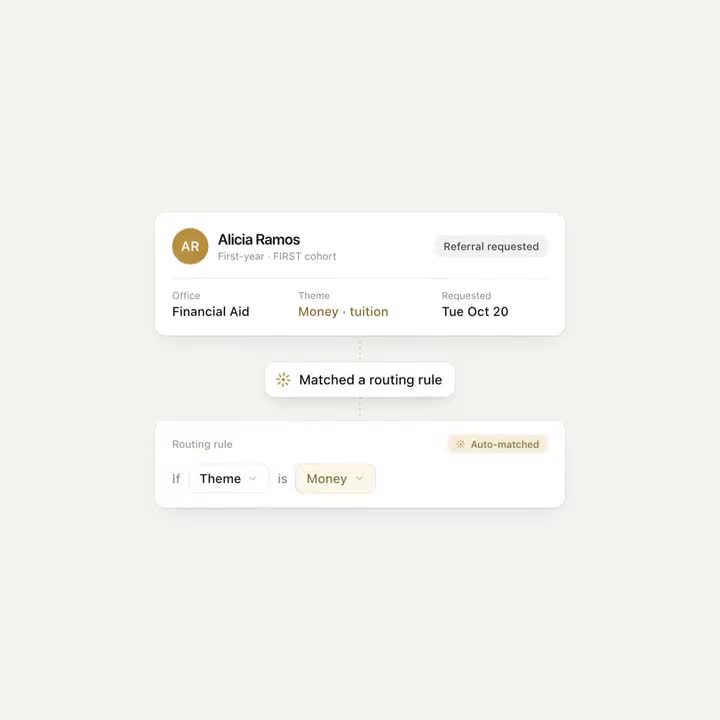
The order matters, and so does the word "free" near the top of the message. Journey's support-map demo shows the idea as a rule set once: when a student needs a tutor, the free peer tutor comes before the paid one, and the advisor is told. That map, and booking straight into the tutoring center, aren't live yet; today the free options lead the text, followed by a link to the center's own booking page.
The texts, from quiz to check back
Here is the sequence for one student after the first quiz in an intro chemistry course: one question, a specific offer that says what to bring, and a check back.
 Journey
Text Message
Tue 5:30 PM
first chem quiz is back. how'd it land? a) good b) ok c) rough
c
thanks for being straight with me. chem tutoring is free, and there's an intro chem session thu at 6 in the library. want the link to grab a spot?
is it weird to go after one quiz
no, that's the best time to go. waiting till the midterm is the harder way. here's the link, 30 seconds to book. bring the quiz, they'll start from what you missed.
Fri 12:15 PM
how was tutoring? a) helped b) meh c) didn't make it
a
love that. same time next week?
An illustrative thread with a fictional student. The first quiz sets the moment, and the check back offers a standing slot. Two unprompted texts that week.
Each answer to the check back gets its own next step:
- a, helped: offer the same slot next week. A standing slot is how a one-off visit becomes a routine.
- b, meh: ask one follow-up (was it the tutor, the time or the subject) and try a different tutor or a group session.
- c, didn't make it: no guilt, just "want another time?" with this week and next week as lettered choices. Two misses in a row is a signal for an advisor, not a third text.
Make booking one tap, and tell the tutor why
Plenty of tutoring centers book through a portal that asks the student to sign in, pick a subject from a long list, choose a course code and then find a slot. Each step loses someone. A link that opens straight to the right course's open slots cuts that to one tap.
The second half is context. If the student has said the problem is stoichiometry, or that they missed two weeks with the flu, the tutor should know that before the session starts, with the student's consent. A tutor who opens with "I hear stoichiometry is the sticking point" saves the first ten minutes and shows the student someone was listening.
Four things to ask of faculty
Faculty are among the most credible voices a student hears about tutoring. A few requests worth making of the departments with your highest-enrollment gateway courses:
- Return the first quiz or problem set by week four, so there's a moment to ask in.
- Announce the course's tutoring session in class and put it on the course homepage, with the day, time and room.
- Send the whole section to the first review session. When everyone is invited, nobody is singled out.
- Include a tutoring referral in early alerts for that course, so the alert carries a next step.
What Journey handles after the first quiz
Journey takes the texting off your staff's plate. It asks after the first graded work, in the window each student chose, and offers your free options first with a one-tap link to book. It tells them what to bring, sends the check back after, and pays attention to how students answer: "i went but i'm still lost" goes to an advisor through the partner dashboard, while "the tutor was great, can i keep her" just gets the link for next week. Students can also text a question like "where are the chem tutors" at 11 PM and get the room and hours from the campus resource details gathered at setup.
The cap matters here. A student enrolled in four courses could qualify for four tutoring nudges in the same week. Journey keeps the total to a few texts a week, inside the windows the student chooses, and no more than one unprompted text a day, so when you set up the campaign, give the slot to the course where students struggle most.
What to report
Visits are the number tutoring centers usually report. They are also the number most easily inflated by a small group of loyal regulars. Report these instead, by course:
- Unique students served, by week. Shows whether you're reaching new people or the same ones more often.
- First-time visitors in weeks three to six. The early window is when a student has the most term left to use the help.
- Share of students with a low first grade who visited within two weeks. This measures whether the ask reached the right students in time. Pick the threshold with the department.
- Second visits. A second visit is the first sign a student is building a habit rather than putting out a fire.
- Referral completion from early alerts. Sessions kept divided by tutoring referrals made.
Start with one course
Pick the gateway course with the most early alerts last year. Get the session schedule from the tutoring center, ask the professor to return the first quiz by week four, and run the sequence from that quiz to the midterm. Report unique students and first-time visitors weekly. By midterms you'll know whether the students who usually turn up in the finals-week line are coming in while there's still time to help.
Frequently asked questions
How can a university increase tutoring center usage?
Reach students right after their first graded work in a course, say plainly that tutoring is free, and send a link that opens to that course's open slots. Ask faculty to announce sessions in class and invite whole sections, then check back with students after their first visit.
Why don't struggling students use tutoring?
Common reasons are stigma, not knowing tutoring is free, not realizing they're behind until the midterm, booking friction, and uncertainty about what happens at a first session. Each has a simple fix, from inviting whole sections to telling students what to bring.
What metrics should a tutoring center report?
Unique students served by week and course, first-time visitors early in the term, second visits, referral completion from early alerts, and the share of students with a low first grade who came in within two weeks. Total visits alone can be inflated by a small group of regulars.
How do we show whether tutoring improves grades?
Comparing students who chose tutoring with those who didn't will overstate the effect, because the two groups differ. For an outcome figure, ask your institutional research office to design a fair comparison before the term starts.