Routing Student Referrals to the Right Office

Most referrals get lost between offices. How to route each one by what the student actually said, give it one owner, share context only after the student says yes, handle busy weeks in batches, and close it.
Key takeaways
- Route by what the student said, not by who raised the flag. The reply decides the owner.
- Every referral needs one named owner, a response expectation set by urgency, and a backup.
- Ask the student first, then send the context they agreed to share, so nobody has to tell their story twice.
- A referral is closed when the student got help and the record says what happened, not when it was sent.
Ask five offices who should own a student who writes "honestly i don't know if i can afford to come back in spring," and you'll often get five answers. Financial aid, because it's about money. Student accounts, because there may be a balance. The advisor, because the student is thinking about leaving. The dean of students, in case there's a crisis behind it. Retention, because that's the job. On a lot of campuses the real answer is whoever saw it first, who forwards it to a shared inbox, where each office assumes another one has it.
Student referral routing is how a concern gets from the person who heard it to the person who can help. It works when four things hold: the referral goes where the student's own words point, it has exactly one owner, it carries the context the student agreed to share, and it ends with the student knowing what happened. Busy weeks, when replies arrive by the hundred, need one more habit: batching.
Why student referrals get lost
| Where it breaks | What happens |
|---|---|
| Routed by who raised it | A professor's flag goes to advising, even when the problem turns out to be rent |
| Copied to everyone | Three offices see it, and each assumes another acted |
| No context | The student has to tell the story again, and some won't |
| No yes from the student | An office the student never asked for gets in touch, and the student doesn't answer |
| No confirmation | The student doesn't know anyone has it, so they give up or start over elsewhere |
| Closed at "referred" | Nobody checks whether the appointment happened |
Route by what the reply is about
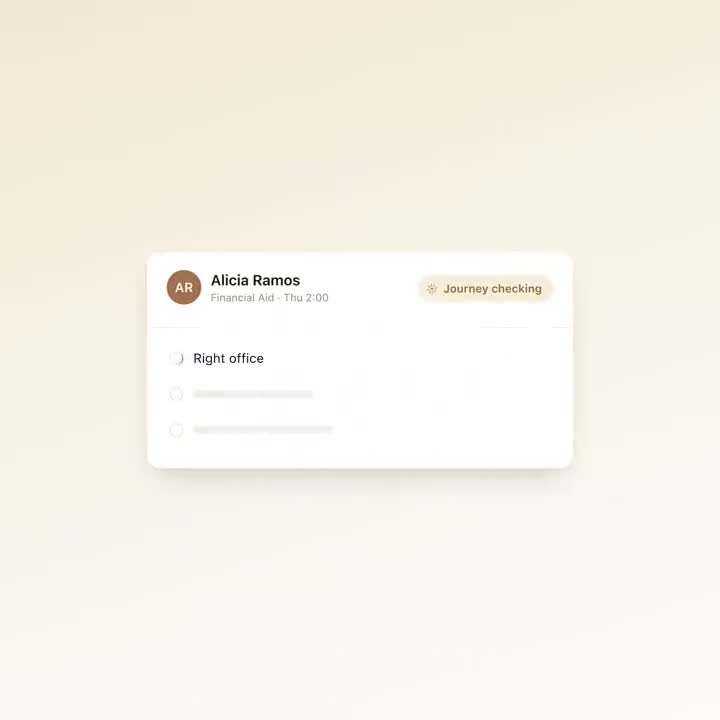
The most useful change on many campuses is to route by what the student said, not by where the flag came from. A missed-labs alert from chemistry can turn out to be about a work schedule, a bus pass, a roommate or grief. The reply decides the owner.
Write down a routing table that your offices agree on. This one is illustrative; your offices and their names will differ.
| When the reply is about | First owner | What they need to know |
|---|---|---|
| Tuition, a bill, aid | Financial aid, or a one-stop office | Whether it's a balance, an aid question, or a cost the student can't cover |
| Food, housing, a sudden expense | The dean of students or basic-needs staff | What's due, and when |
| A course going badly | Tutoring, then the advisor | Which course, and whether a deadline is near |
| Registration or a hold | A one-stop office or the registrar | Which hold, and the student's registration time |
| Stress, sleep, mood | Counseling, if the student wants it | The student's own words about what they'd like |
| Safety language | On-call staff, under your escalation process | Everything, right away |
| Internships, jobs, a major | The career center | Year, major and the question they asked |
| Loneliness, homesickness | Res life or a peer mentor | Whether they live on campus |
| Leaving or transferring | Their advisor, or a retention lead | The reason they gave |
| Accommodations | Disability services | Only what the student chooses to share |
When a reply touches two themes, route by the one that's blocking. "i can't pay the bill so i'm not registering" is a money referral with a registration note, not two referrals. Two owners usually means no owner.
Treat the table as a draft. Review it each term with the offices on it, using the re-routes from the term before: every referral that bounced from its first owner is a row that needs rewriting, or a theme the table didn't have.
Give every referral one owner
- A named person, or a staffed queue with a named lead. Never a shared inbox that nobody owns.
- A response expectation by urgency. For example: safety immediately, under your escalation process; urgent the same day; routine within two business days. Pick your own and publish them to staff.
- A backup for every owner, for vacations and the first week of term.
- A way to hand it back. If the first owner is the wrong one, they re-route it with a note instead of closing it.
Ask the student first, then send the context
Before a referral goes anywhere, the student should say yes. It's the step that makes the rest work. A student who agreed to hear from financial aid answers financial aid. A student who was referred without knowing often doesn't.
 Journey
Text Message
Mon 4:15 PM
thanks for telling me. money stuff is exactly what financial aid is for. want me to pass this to the student success team, so financial aid gets the whole picture and you don't have to explain it all again? a) yes, send it b) i'll explain it myself c) not yet
a
done. the team has your note and will get it to financial aid, so you won't have to start from scratch. here's their booking link too, if you'd rather pick a time yourself.
An illustrative thread with a fictional student. The student says yes before anything is shared.
Respect the other answers, too. A student who picks "i'll explain it myself" gets the booking link and nothing is sent. A student who picks "not yet" gets a check back in a few days, and a safety concern is the only thing that overrides either answer.
What travels with the referral: the theme, the student's own words if they agreed, what's already been tried, any deadline, and how the student likes to be reached. What doesn't: the rest of their conversation. The receiving office needs enough to start the meeting in the right place, not a transcript.
Batch the busy weeks
After a campus-wide check-in in week five, replies don't arrive one at a time. Hundreds can come in over two evenings, and routing them one by one is how the last fifty wait a week. Batch them instead.
- Sort by urgency first. Safety language is handled immediately and never waits for a batch.
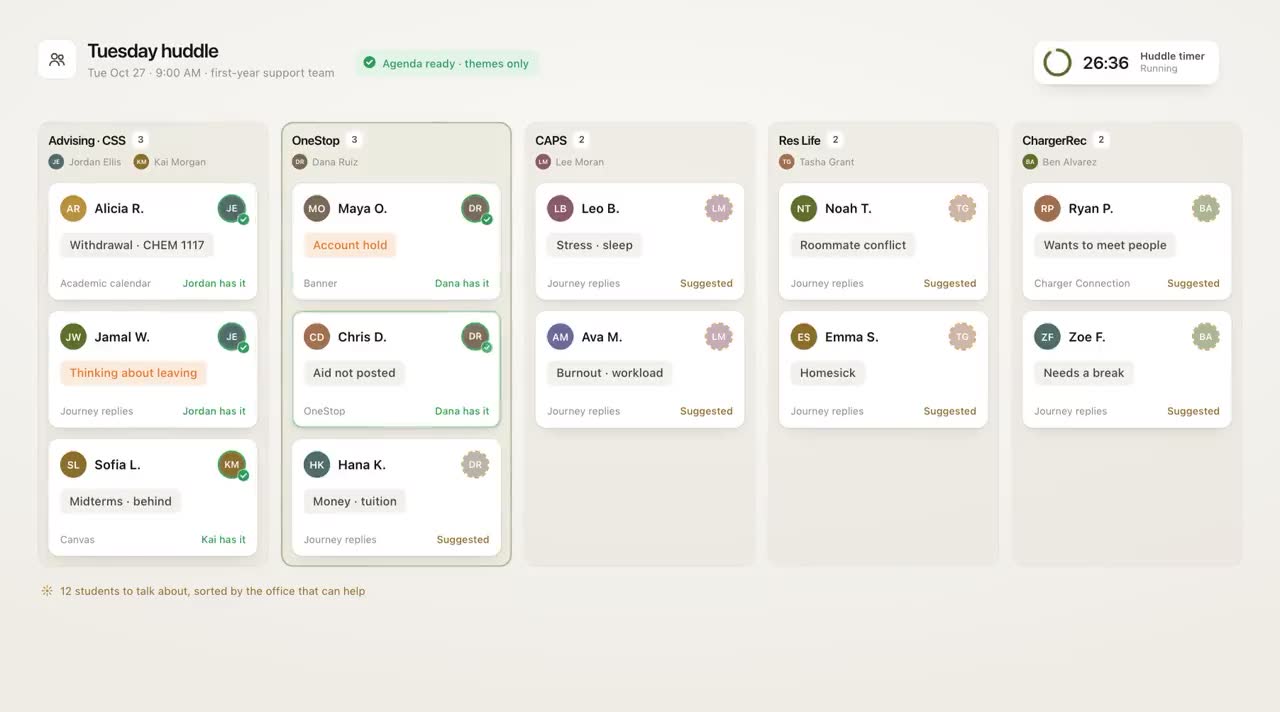
- Group the rest by theme: money, courses, registration, belonging.
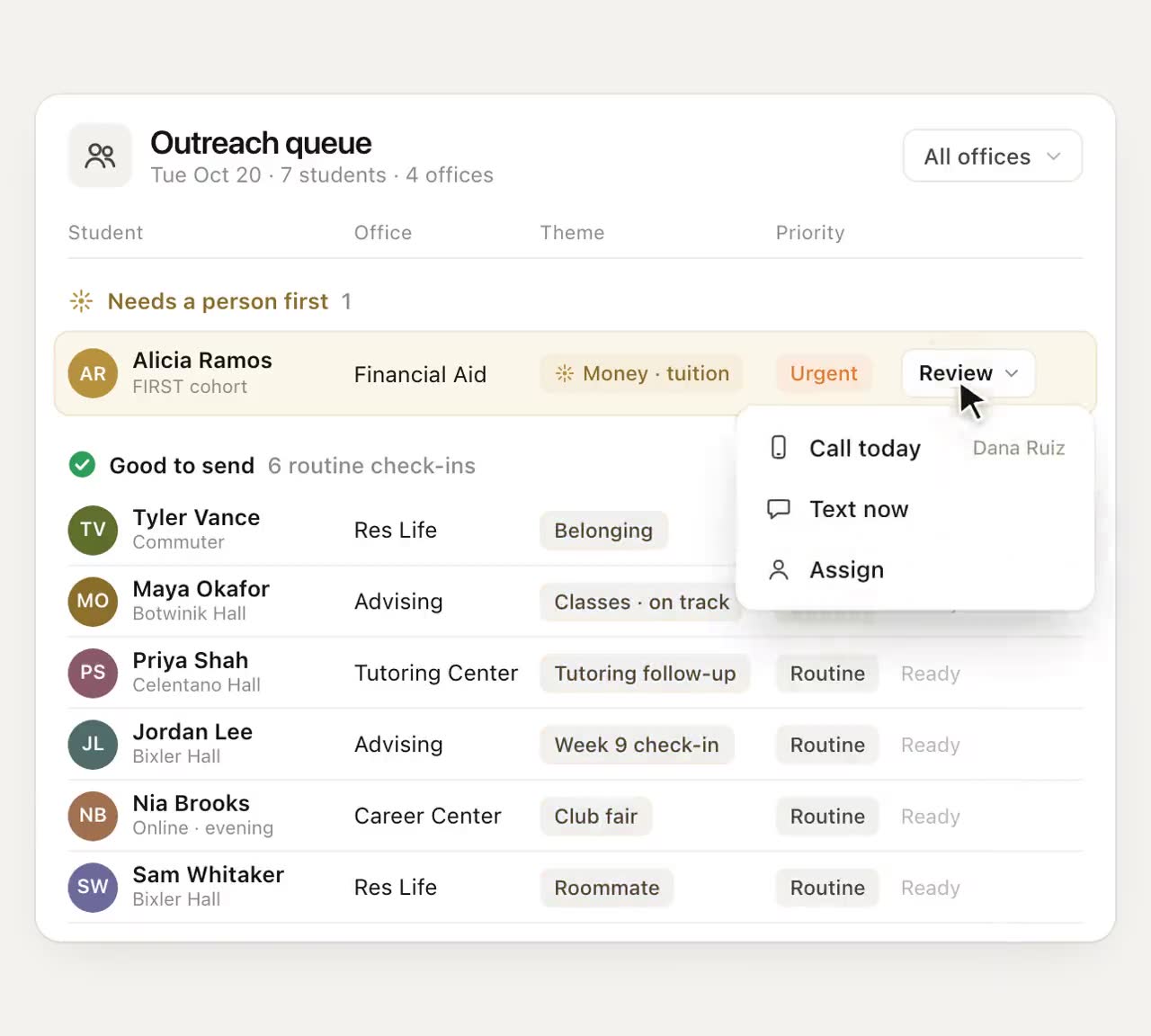
- Hand each group to its owner as one list, with each student's context and consent.
- Write back to every student, so nobody is left wondering whether anyone read their reply.
- Check the lists a few days later for anything nobody picked up.
Confirm, check back, close
A referral isn't done when it's sent. It's done when the student got help and the record says so.
- Confirm to the student who has it and when to expect contact: "dana in financial aid, by wednesday."
- Confirm to whoever raised it, in one line, with no private detail.
- Check back after the appointment. Did it happen, and did it help?
- Close with an outcome, not a status. "Aid adjusted, registered for spring" tells next term's advisor something. "Referred" tells them nothing.
For the full loop on faculty alerts, see How to Close the Loop on Every Early Alert.
Getting each reply to its owner
Journey works out what each reply is about and how much it matters, and a few kinds of message skip the queue. A student in crisis gets an immediate reply with 988 and campus health and wellness, and your campus team is alerted. A student who says they're leaving the university triggers a staff notification. A student who texts "talk" is told a staff member will reach out as soon as possible. Everything else shows up on the partner dashboard as a short list of students for your staff, with each student's themes rather than their transcript, and staff alerts can also go to your team's Slack. Students get a one-tap link to book the office that can help, and a personal follow-up, written by Journey and approved by your staff in Slack before it goes out, can check back afterward. Journey processes student data only under a written agreement with the institution, as a school official with a legitimate educational interest, and SOC 2 certification is in progress.
Some of what our routing videos show isn't live yet: a rule builder where you set "money questions go to Financial Aid" once and approve each handoff, cases opening automatically in a success platform such as Navigate360, and routing a batch of replies in one go. Today your team routes from the dashboard, and every practice in this playbook works in whatever tool you already use.
What to measure
- Time from reply to owner acknowledgment, by urgency level.
- Re-routes. How often the first owner was the wrong one. A high rate on one theme means the routing table needs a fix.
- Referrals with exactly one owner. Anything else is a gap waiting to happen.
- Students who had to retell their story. Ask them, in the check back.
- Referral completion: appointments kept divided by referrals made.
- Closed with an outcome, versus closed with a status.
Questions to ask any vendor
- Who decides where a referral goes: the source of the flag, or what the student said?
- Does the student agree before anything is shared, and what exactly is shared?
- How is a single owner enforced, and what happens when that person is out?
- What happens to safety language at 2 AM on a Saturday?
- Does the student hear back, and does anything check that the appointment happened?
Start with the table. Get the offices in one room for an hour, agree on the first owner for each theme, and publish it. It costs nothing, and it settles the question in the first paragraph of this article before the next student asks it.
Frequently asked questions
What is student referral routing?
It's how a concern about a student gets from whoever heard it to the person or office that can help. Good routing sends each referral where the student's own words point, to one owner, with context the student agreed to share.
Who should own a student referral?
One named person, or a staffed queue with a named lead, chosen by what the student's reply is about. Shared inboxes and copying several offices are how referrals get lost.
How fast should a referral be acknowledged?
Set expectations by urgency and publish them to staff. A common pattern is safety concerns immediately under your escalation process, urgent issues the same day, and routine ones within a couple of business days.
Do we need student consent to share referral details between offices?
FERPA generally allows school officials with a legitimate educational interest to share records within the institution, but asking the student first builds trust and makes them more likely to answer the office. Check your own policy with your counsel.
What if a student's reply fits more than one office?
Route it by the theme that's blocking the student, and add the other as a note for the owner. Two owners usually means no owner.