When a Student Says They're Thinking About Transferring

A student who says "probably not" about next term has told you more than a risk score. Ask why first, route by reason to a named person within two business days, skip guilt and pamphlets, and help them leave well if that's right.
Key takeaways
- Ask why before offering anything. Lettered reasons let a student name money, belonging, a missing program or family in one reply.
- Each reason has a different owner: financial aid for money, a retention coordinator or Res Life for belonging, an advisor for programs and grades, the dean of students for family.
- Get a named person in touch within two business days. Transfer decisions can harden quickly.
- Skip the guilt, the pamphlet and the pitch. When transferring is the right call, help the student leave well.
Late October, 4:06 on a Tuesday. A first-year answers a check-in about next term with one letter: D, "probably not". She has just told you something no risk score could: she isn't planning to come back. What happens in the next two days can decide whether she transfers because it's the right move for her, or because nobody asked her why.
When a student wants to transfer, retention depends less on persuasion than on a fast, honest question and the right person following up. This playbook covers what to ask first, the common reasons and who owns each, how fast to move, the exact texts, what not to do, and how to measure it without turning students into saves and losses.
Ask why before anything else
The instinct is to respond with something: a scholarship reminder, a list of clubs, an invitation to meet the dean. Resist it. Until you know the reason, any offer is a guess, and a wrong guess tells the student you weren't listening.
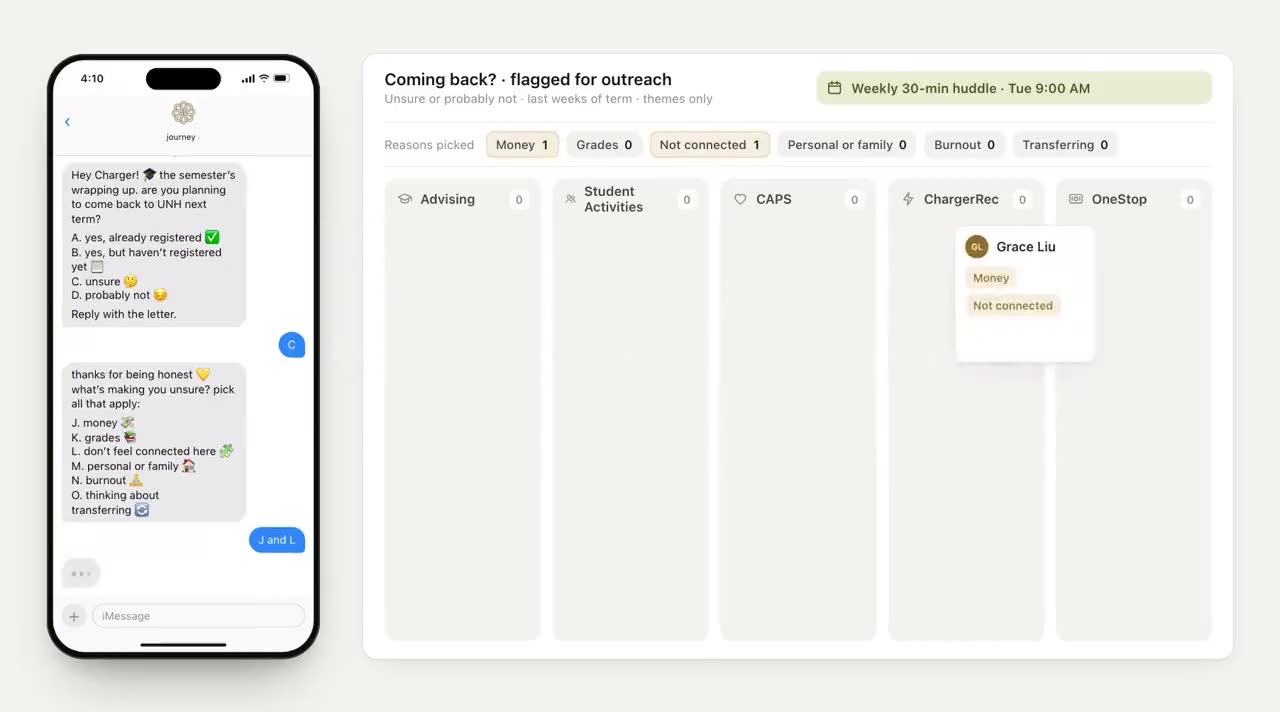
The first reply should do three things: thank them, take the pressure off and ask why, with choices that make it easy to answer.
 Journey
Text Message
Tue 4:05 PM
the semester's flying by. are you planning to come back next term? a) yes, for sure b) probably c) unsure d) probably not
d
thanks for telling me, really. no pressure either way. can i ask what's behind it? pick any that fit: a) money b) classes or grades c) not feeling connected d) a program we don't have e) family or home stuff
c and a
that makes sense, and both of those can change. a real person who can help with each will reach out this week. whatever you decide, i'm here.
An illustrative thread with a fictional student. One question, then why, then a promise of a person.
Two details matter. "Pick any that fit" lets a student name more than one reason, and students thinking about leaving often have more than one. And "a real person will reach out this week" sets an expectation your team now has to meet. Only send it if they will.
When to ask about next term
Most students who are thinking about transferring won't announce it. You find out by asking everyone, at moments when the question is natural, rather than waiting for a withdrawal form.
| When | Why then | Who gets it |
|---|---|---|
| Mid-fall, a few weeks before spring registration opens | Early enough to fix a hold, an aid gap or a schedule before registration | All first-years, and any transfer students in their first term |
| The first week of spring term | First-term grades are in and break gave students time at home to reconsider | Students who said "unsure" or "probably not" in the fall, plus anyone new to the list |
| Early spring, before fall registration | Students weighing a move for the fall are often deciding now | Everyone in the first and second year |
| After a known jolt | A big aid change, a housing problem, a failed gateway course | Only the students affected, from the office that knows |
Two or three times a year is enough. Ask more often and the question starts to feel like pressure, which is the opposite of what you want.
The common reasons, and who owns each
Transfer intent usually comes down to a handful of reasons. Each has a different owner and a different first move.
| Reason | What it often means | Owner | First move |
|---|---|---|---|
| Money | The aid package didn't cover next year, a balance is growing, or a cheaper school is closer to home | A financial aid counselor | Review the actual numbers together: aid for next year, appeals, payment plans, work-study |
| Not feeling connected | No friends yet, goes home most weekends, feels out of place | A retention coordinator, with Res Life or a peer mentor | A conversation, then one specific connection: a person, a group, an event |
| A program you don't offer | They came for one major and want another you don't have | An academic advisor who knows the catalog | Check for real alternatives honestly. If there's none, help them transfer well |
| Family or home | A parent is sick, they're needed at home, they miss home | The dean of students office or a case manager | Ask what they need. Leave of absence, online or part-time options may matter more than staying full time |
| Classes or grades | A bad first term, wrong major, feeling behind | An academic advisor | A plan for next term: course load, tutoring, maybe a different major |
When a student names two reasons, pick a lead owner, usually for the one that's most urgent or most fixable, and make sure that person knows about the second one. Two offices reaching out separately feels like being processed.
How fast, and who does what
Transfer decisions can harden quickly. A student who says "probably not" in October may have applications in by the holidays. Speed matters, and so does making sure the first human contact is personal.
| When | Step | Owner |
|---|---|---|
| Same day | The "why" question and the promise of a person | Sent by text; the retention coordinator approves the wording in advance |
| Within one business day | A lead owner assigned by reason, with the theme and nothing the student wrote verbatim | Retention coordinator |
| Within two business days | First personal contact from the owner, by text or phone, from a named person | The lead owner |
| Within a week | A real conversation, in person or by phone | The lead owner |
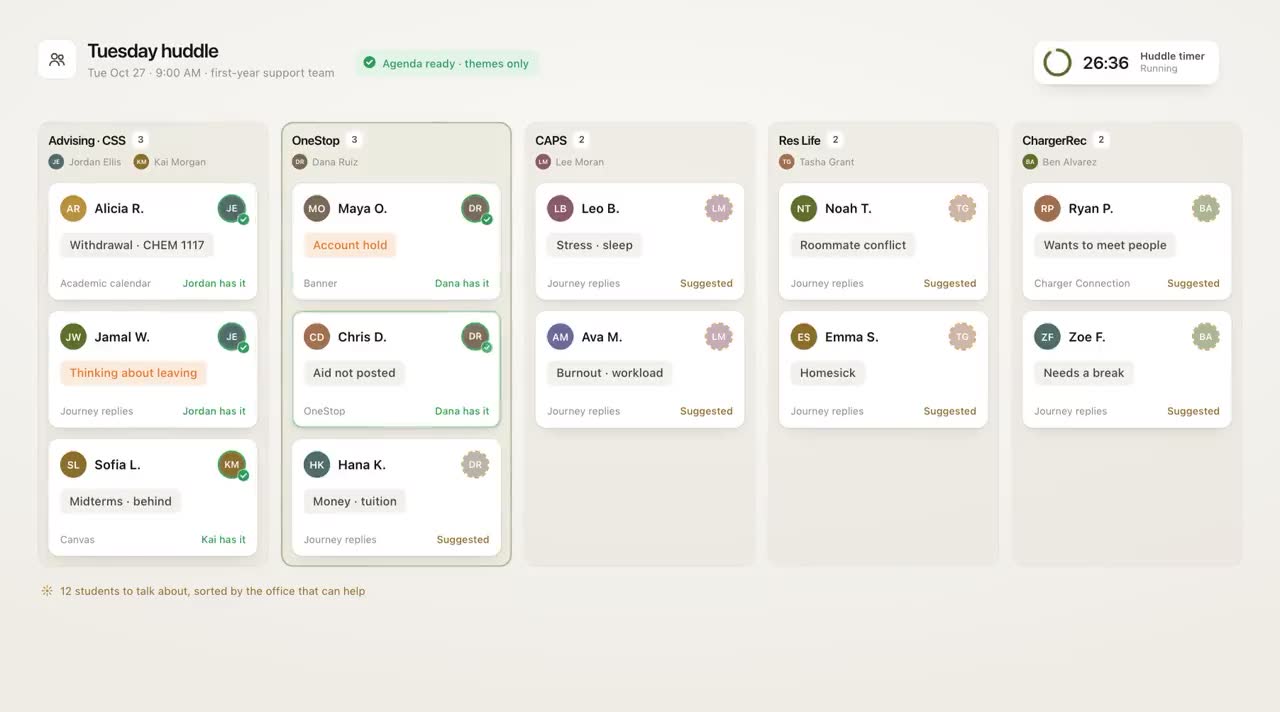
| Weekly | Every open case reviewed: reason, owner, last contact, next step | Retention team huddle |
| Before registration and before the withdrawal deadline | A check-in on where the student landed | The lead owner |
Those windows are the ones we'd start with. Adjust them to your staffing, but write them down. "As soon as possible" in a busy October means next week.
What the first human contact should sound like
The owner's first message should be short, personal and free of agenda. Not a form letter from a generic address. A text or a call from a person with a name.
| Reason | First message from the owner |
|---|---|
| Not connected | "hi alicia, it's priya from res life. i heard it's been a lonely semester. no agenda, i'd just like to hear how it's going. coffee thu at 3, or a call?" |
| Money | "hi alicia, dana from financial aid. you mentioned money is part of it. want 20 min to look at next year's numbers together?" |
| A program | "hi alicia, marcus from advising. which program are you looking at? i'll be honest about what we have and what we don't." |
Each one names who's writing, reflects the reason in plain words, and offers a specific next step with an easy way to say yes. None of them promises a result. The first message promises a look, a conversation or an honest answer, which the owner can always deliver.
What not to do
- Don't lead with guilt. "Have you thought about what you'd lose?" puts the student on the defensive and ends the conversation.
- Don't send a pamphlet. A PDF of campus resources in reply to "i don't feel connected" confirms the feeling.
- Don't pitch. The student isn't a prospect to re-recruit. Admissions language ("here's why students love it here") sounds like it.
- Don't promise what you can't deliver. If the aid office can't change the package, say so early.
- Don't treat "probably" as "yes". The students who pick "probably" or "unsure" are the easiest to overlook, and their reasons may be the easiest to address.
- Don't quote them back to a room. Their words stay private. The huddle sees the reason and the owner, not the transcript.
When transferring is the right call
Sometimes it is. The student wants a program you don't offer, or needs to be home for a parent, or will be better off at the community college close to work for a year. In those cases the retention goal changes: help them leave well.
- Clear the path. Holds resolved, transcript requests explained, any refunds or balances sorted before they go.
- Protect their credits. An advisor's honest read on what will transfer, and which courses next term would carry over best.
- Leave the door open. "If it doesn't work out, here's how to come back" in writing, with a name.
Students talk. A student who was helped to leave well tells a different story about your campus than one who was guilted. And some of them, once they feel heard rather than chased, may decide to stay after all.
How Journey asks, and who it tells
Journey asks the intent question as a lettered check-in inside a campaign your team schedules for the right weeks of the term. Each answer is recorded against that check-in, and for anyone who says "unsure" or "probably not", the follow-up asking why can go out the same day, written by Journey and approved by your staff in Slack before it's sent. A student who picks "not feeling connected" is flagged on the partner dashboard with that reason, not her words, and the alert reaches your team's Slack. The question isn't the only way in, either: a student who texts that they're leaving the university, at any point in the term, triggers a staff notification the same way. In our demo the flag goes a step further and lands on the team's huddle agenda by itself; that automatic agenda isn't live yet, so today the coordinator adds it.
One pilot shows what's at stake in a single cohort. Of about 100 high-risk first-years in the University of New Haven pilot, 4 left. The semester before Journey, 50 high-risk first-years did.
What to measure
- Who answered the intent question, and the share in each answer. Ask everyone, not only flagged students; transfer intent can show up in students with good grades whom no risk model would flag.
- Time to first human contact for "unsure" and "probably not", in business days.
- Reason mix, by term and by group. If money dominates, that's a conversation for the aid office and the budget, not for outreach.
- Registered for next term, among students who said "unsure" or "probably not", against the same group last year.
- Left well. For students who transferred anyway: holds cleared, transcript sent, and whether the door was left open. A good exit is an outcome too.
Start with first-years in the fall. Staff the follow-up before you send the first text, review every open case at the weekly huddle, and by spring registration you'll know which reasons your students actually have, and which ones your campus can do something about.
Frequently asked questions
What should you do when a student says they want to transfer?
Thank them, take the pressure off and ask why, with a few reasons they can pick from. Then assign a named person who owns that reason, such as a financial aid counselor for money, and have them reach out personally within two business days.
Why do college students transfer?
Common reasons include cost and aid, not feeling connected, wanting a program the school doesn't offer, family needs and academic struggles. Students often have more than one reason, which is why it helps to let them pick several.
How can a university reduce transfer-out rates?
Ask all first-years about their plans for next term at a few points in the year, not just flagged students, and follow up quickly and personally with anyone who is unsure. Track the reasons, because a pattern such as money may call for a policy change rather than more outreach.
Should advisors try to talk students out of transferring?
No. Listen first and fix what can be fixed. When transferring is genuinely right for the student, help them leave well, with holds cleared and credits protected, and leave the door open to come back.