Mainstay Alternatives for 2026

Mainstay is now a division of Lemnis, a public charity. What changed, what Mainstay says it does, the alternatives by category, when staying is the right call, and a checklist for switching texting vendors safely.
Key takeaways
- In March 2026, Lemnis, which describes itself as a public charity, announced Mainstay would convert from a public benefit corporation into a division of Lemnis.
- The announcement said its divisions would stay focused on current services, so for many campuses renewing is reasonable. Get contract, data and roadmap answers in writing either way.
- Alternatives include check-in chatbots, the texting inside your success platform, staff texting platforms and follow-through tools like Journey.
- If you switch, export consent records and opt-outs first, settle the phone number, audit the content, write down a baseline and switch between terms.
In March 2026, Lemnis, which describes itself as a public charity, announced that Mainstay would convert from a public benefit corporation into a division of Lemnis. In February, Lemnis had announced its acquisition of InsideTrack, the student coaching nonprofit. If your campus uses Mainstay, the change will come up at your next renewal, even if nothing about the service itself has changed.
For many campuses, the right answer will be to renew. The announcement said both divisions would stay focused on the services they already provide. But a change of ownership is a natural moment to ask whether the tool still fits the job you need done this year, and if you're searching for Mainstay alternatives, you're probably asking. This guide covers what changed, what Mainstay says it does, the alternatives by category, where Mainstay may still be your best option, and a checklist for moving texting vendors without losing consent records, opt-outs or students' trust.
What changed at Mainstay, and what didn't
According to the March 24, 2026 announcement, Mainstay will operate as a division of Lemnis rather than as a public benefit corporation, and the deal was Lemnis's second transaction of the year. GovTech quoted Mainstay's chief executive as saying the nonprofit structure would let the company expand its reach and maintain its work with institutions. Mainstay's own website now describes it as a division of Lemnis.
What the public record doesn't tell you is anything about your contract: pricing at renewal, support levels, data-processing terms or the product roadmap. Those are questions for your account team, and you should ask them in writing.
What Mainstay does, as it describes it
Mainstay describes its approach as human-centered and AI-enhanced. Its website names three parts: AI success coaching that puts a personalized coach on each student's phone, a conversation co-pilot meant to save staff time, and conversation insights that surface student needs to leaders. It describes evidence-based messaging and pre-built conversation libraries, and lists SMS, live chat, web chat and social media as channels. Its about page says it began in 2014 as AdmitHub, using behavioral science and AI to help students get to college, and later moved into student success coaching. The Lemnis announcement put Mainstay's technology at more than 200 colleges and universities.
That history matters when you compare. Mainstay's roots are in helping students get to college through conversation at scale, and its site frames the work as running from college access through student success. That's a different starting point from a tool built to check in on enrolled students, or one built to get a struggling student through a door.
Why campuses review at renewal
- The question changed. Three years ago the goal might have been answering FAQs at 1 AM. Now it's getting first-years in a high-risk cohort to actually show up for tutoring.
- Too many senders. Your success platform added texting, the financial aid office bought its own tool, and students get texts from four campus numbers.
- The staff view. Advisors may want a short weekly list of who needs them, and a renewal is a fair time to check whether your current setup gives them one.
- The contract. Any change of ownership is a good time to reread the data, termination and export terms, whatever you decide.
The alternatives, by category
Stay, and renegotiate
If the tool works and your students answer it, staying is a legitimate choice. Use the renewal to get written answers about data terms and roadmap, and to set the measures you'll judge it by next year.
A check-in chatbot
EdSights describes AI-powered texting that checks in with students every 7 to 10 days across four persistence drivers, flags students by risk level for advisor follow-up, and comes with a whitelabeled chatbot that answers questions from a knowledge base EdSights builds and maintains.
The texting inside your success platform
EAB lists two-way SMS, a student app and a student-facing AI knowledge agent among Navigate360's features. If you run it, check what you already own.
A staff texting platform
Modern Campus Message (formerly Signal Vine) describes two-way texting with AI-driven automation and one-to-one conversation in a single thread. Mongoose describes two-way conversations across text, WhatsApp and web chat, with AI agents for staff. Both are built around your offices' outreach.
A follow-through layer
Journey, described below.
What to look for in any alternative
| Look for | Why it matters | How to test it |
|---|---|---|
| Outreach first, not only answers | The students most likely to leave are the least likely to ask a question | Ask what a student who never texts in gets in their first three weeks |
| A campus resource base someone owns | Dining hours, break dates and office locations change every term | Ask who updates it, how often, and what happens when it's wrong |
| An honest "I don't know" | A confident wrong answer about a deadline costs more than no answer | Ask something the system can't know and watch what it does |
| Replies read for meaning and urgency | A one-word reply can be the most important message of the week | Send "idk anymore" in the demo and see where it goes |
| A staff view built for triage | Nobody has time for transcripts in week nine | Ask to see an advisor's Monday morning |
| Data you can take with you | You're reading this because a vendor changed | Ask what you get back at the end, and in what format |
Following through after the first text
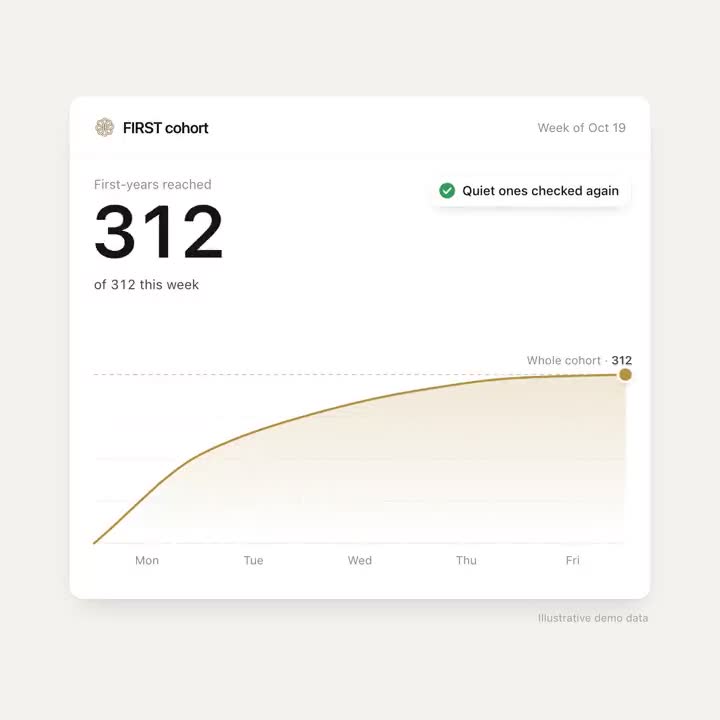
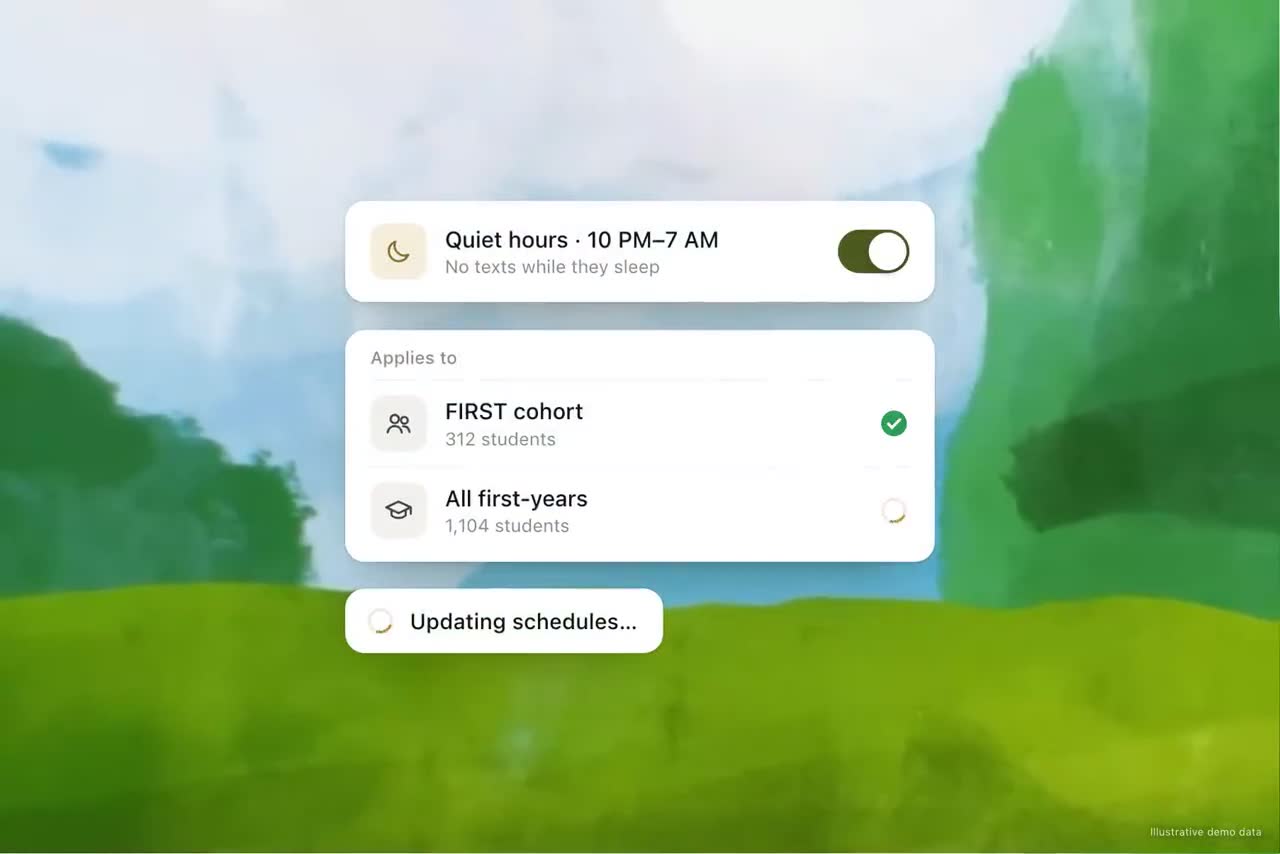
Other tools are good at finding out who is struggling or answering what students ask. Journey is built for follow-through: getting the student to act. It texts first, over SMS or iMessage, with nothing to install and no new password. Students spend about 90 seconds on onboarding, ranking their goals and picking the voice Journey texts them in, and the nudges that follow are built from those goals, a few texts a week, inside the windows the student chooses.
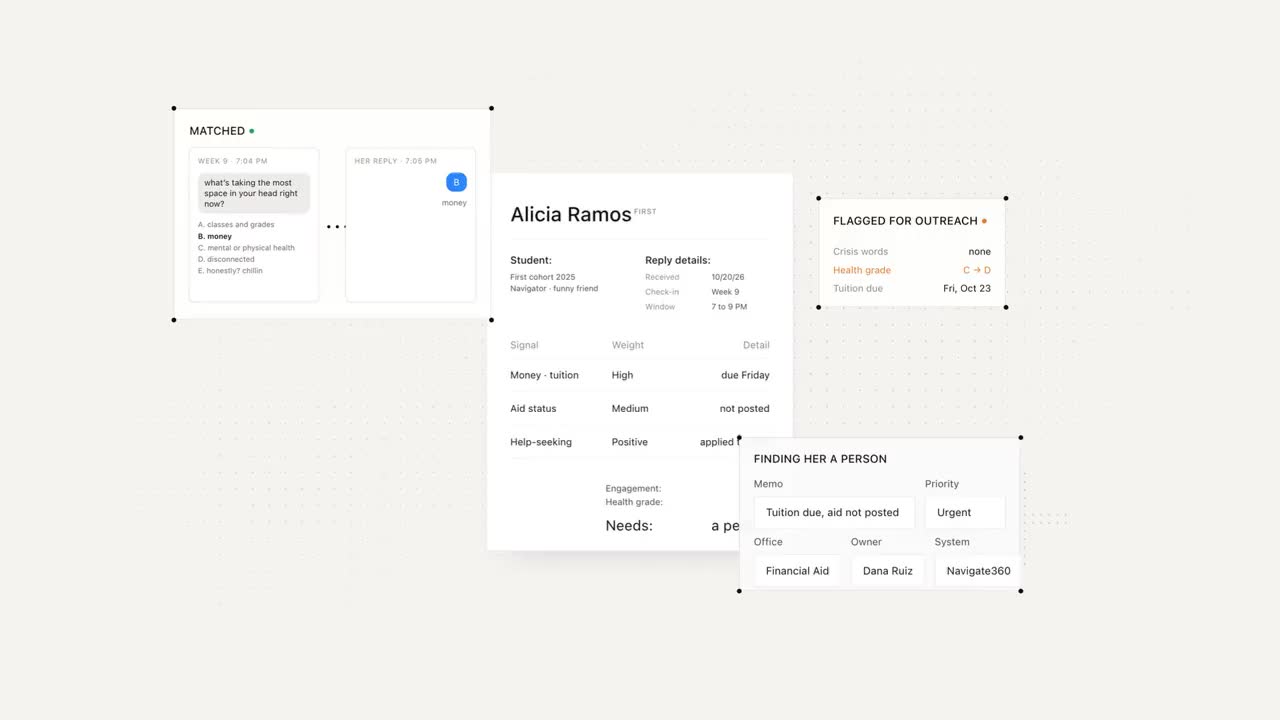
Students can ask about campus any time, and answers come from a resource base gathered at setup; where Journey doesn't know, it says so and points to a person. Each reply is sorted by topic and by how soon a person should see it, safety language goes to people, and a one-tap scheduling link takes the student to the office that can help. Staff get a short list of students to contact, with the gist of what each one said rather than the transcript. In a typical week of the University of New Haven pilot, 74% of students replied to Journey or acted on a nudge.
Where Mainstay may still be the better fit
- You need more channels than texting. Mainstay lists live chat, web chat and social media alongside SMS. Journey works over SMS and iMessage only.
- Your use starts before students enroll. Mainstay began by helping students get to college. Journey is built for student success after students enroll, not for recruitment.
- You rely on its conversation libraries and services. Mainstay describes pre-built conversation libraries and lists expert services on its site. If your team leans on them, switching means replacing both.
- The numbers are good and your students answer. Then the ownership change is a reason to review terms, not to switch.
A transition checklist for changing texting vendors
Whatever you choose, moving from one texting system to another has a handful of steps that go wrong quietly. Work through them before the last day of the old contract, not after.
- Export consent records. For every student: when they opted in, how, and the wording they saw. Consent is central to texting rules, including the TCPA in the US, and to carrier policies. Keep the export, and ask your counsel what you need to retain.
- Export opt-outs, with dates. Load them into the new system before its first send. A student who texted STOP to the old number should not hear from the new one without fresh consent. Never send a "we've moved" text to someone who opted out.
- Settle the phone number. Ask whether the number students already recognize can move with you under your contract. If it can't, introduce the new number from a channel students trust, such as a note from the dean of students' office, and make the first text say plainly who it's from.
- Export and audit the content. Pull the knowledge base and message library. Flag anything with a date, an hour, a room or a person's name, because those are the parts that went stale.
- Decide what happens to conversation history. What you keep, where, for how long, and written confirmation from the outgoing vendor of what they delete, as your agreement requires.
- List every feed. Roster, student record, CRM, success platform. Name an owner for each on your side.
- Write down the baseline. Last term's reply rate, referral completion and opt-out rate, each with its denominator and period, so next year's comparison is fair.
- Pick the timing. Switch between terms. Avoid the first six weeks, registration and finals. If you overlap the two systems, give each student one sender, not two.
- Re-test safety routing. New escalation contacts, new on-call numbers, and a test message before go-live, with your counseling center in the room.
Questions to ask
Your Mainstay account team: Does anything in our contract, data-processing agreement or support change under the new structure? What's on the roadmap for the next year? What happens to our data if we leave?
Any vendor you're considering: What does a student who never texts in get in week one? What does an advisor see on Monday? What happens to a reply with safety language at 2 AM? Which features in this demo are live, and which are planned? What does a campus get back at the end of the contract?
A change at a vendor you rely on is unsettling, but it's also the rare moment when everyone on your team is willing to ask what the tool is for. Spend that moment on the answer, and the vendor decision gets much easier.
Frequently asked questions
Is Mainstay a nonprofit now?
Mainstay's website describes it as a division of Lemnis, a public charity. Lemnis announced on March 24, 2026 that Mainstay would convert from a public benefit corporation into one of its divisions.
Should we leave Mainstay because of the ownership change?
Not on that basis alone. The announcement said its divisions would remain focused on their current services. Use the renewal to get written answers about your contract, data terms and roadmap, and to check whether the tool still fits the job you need done.
What are the alternatives to Mainstay?
Check-in chatbots such as EdSights, the texting and AI features in a student success platform such as EAB Navigate360, staff texting platforms such as Modern Campus Message and Mongoose, and follow-through tools such as Journey. Which fits depends on whether you need answers, a channel for staff, or help getting students to act.
How do we switch student texting vendors without losing opt-outs?
Export every opt-out with its date and load the list into the new system before its first send. Export consent records too, with when and how each student opted in. Never text an opted-out student to announce the move, and ask counsel what records to keep.
When is the best time to change texting platforms?
Between terms. Avoid the first six weeks, registration and finals. If the systems overlap, give each student one sender, and introduce any new number from a channel students already trust.